
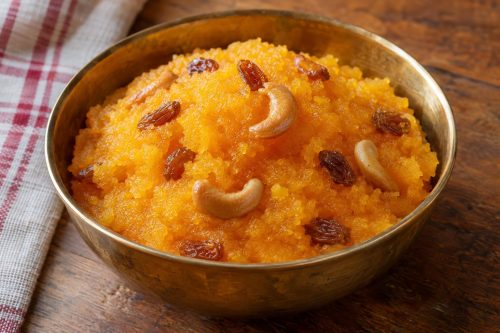
Rava Kesari is one of those South Indian sweets that requires very few ingredients yet delivers a satisfying result when the technique is right. The semolina is roasted in ghee first, which removes the raw smell and helps it absorb the coloured water evenly. Kesari powder gives the dish its familiar bright orange colour. Sugar is added only after the rava is fully cooked, which keeps the texture smooth rather than grainy. Fried cashewnuts and raisins are scattered on top just before serving, adding a little crunch and contrast to the soft, glossy halwa.
About the Recipe
This recipe uses half a cup of rava cooked in two cups of water, which gives a soft, spoonable texture. The ratio of sugar to rava is roughly two to one by volume, so the sweetness is pronounced. Ghee is added in stages: one tablespoon for roasting the rava, the remainder stirred in near the end. The kesari powder dissolves into the water before the rava goes in, so the colour spreads evenly. Cloves are optional but add a mild warmth. The whole process, from roasting to setting, takes between 20 and 30 minutes.
Why You Will Love This Recipe
The strongest reason to make this rava kesari recipe is how quickly it comes together. There is no soaking, no grinding and no advance preparation. The ingredient list is short and most items are already in a typical Indian kitchen. The second reason is the texture: when the rava is roasted properly and the ghee is added at the right stage, the kesari turns glossy and holds its shape on the plate without becoming stiff. It can be served warm straight from the pan or pressed into a small bowl and turned out for a neater presentation.
Cooking Tips
The most common beginner mistake is adding the rava to the water before it is properly roasted. Under-roasted rava can turn sticky and clump. Roast it on a medium flame, stirring continuously, until it smells nutty and turns a pale pink. Keep stirring after the rava goes into the water to prevent lumps from forming. Add sugar only after the rava is fully cooked and the water has been absorbed, otherwise the grains will not soften further. Cook on a low flame after adding sugar so it does not catch at the bottom.
Top Tips
- Roast the rava on a medium flame with continuous stirring until it turns light pink before adding any liquid.
- Add the kesari powder to the water before the rava goes in so the colour distributes evenly throughout.
- Stir the rava continuously for the first two minutes after adding it to the boiling water to prevent lumps.
- Add sugar only after the rava is fully cooked and soft, not before, to keep the texture smooth.
- Fry the cashewnuts and raisins just before serving so they stay crisp on top of the warm kesari.
- If the kesari thickens too much before you serve it, stir in a small splash of hot water and mix well over low heat.
Serving and Storing Suggestions
Rava kesari is best served warm, straight from the pan. It is a common offering at South Indian temple festivals and works equally well as an after-meal sweet or a morning prasad. Leftovers can be stored in a covered container at room temperature for up to one day, or refrigerated for up to two days. Reheat with a few drops of water on a low flame, stirring until it loosens. The texture softens slightly on reheating but the flavour holds well.
Similar Recipes
Nutrient Benefits
Semolina provides carbohydrates that give a quick source of energy, which is one reason kesari is traditionally served as prasad after fasting. Ghee supplies fat-soluble vitamins and helps the body absorb them from food. Cashewnuts contribute protein and minerals including magnesium and zinc. Raisins add natural sugars along with small amounts of iron and potassium. This is an energy-dense sweet, so a small portion goes a long way.
Rava Kesari
Ingredients
- 1/2 cup Rava (Semolina)
- handful Cashewnuts
- handful Raisins
- 3 tbsp Ghee
- a pinch Kesari Powder
- 2 Cloves , optional
- 1 cup Sugar
- For Frying the cashewnuts and raisins
- group
- 1 tsp Ghee
Instructions
- Heat 1 tblsp of ghee in a pan.
- Fry the rava till it turns light pink.
- Remove and keep aside.
- Add 2 cups of water to the pan and add the kesari powder.
- Bring to a boil.
- Add the fried rava and mix well, stirring from time to time.
- Cook for 5 to 10 minutes or until the rava is cooked.
- Add the sugar and mix well until it dissolves fully.
- Add the remaining ghee and cook till the rava starts to leave the sides of the pan.
- In a small frying pan, heat 1 tsp of ghee.
- Fry the cashewnuts and raisins.
- Sprinkle this on top of the kesari and serve at once.
Sign up for our newsletter
Add Awesome Cuisine as a Preferred Source

Frequently Asked Questions
Why does my rava kesari turn lumpy?
Lumps usually form when the rava is added to the water all at once without stirring, or when the water is not boiling when the rava goes in. Make sure the coloured water is at a full boil before you add the roasted rava, and stir continuously for the first two minutes. Adding the rava in a slow, steady stream while stirring also helps prevent lumps from forming.
What is kesari powder and can I substitute it?
Kesari powder is a food-grade orange colouring agent used specifically for this sweet. It gives the dish its characteristic bright colour. If you do not have it, a small pinch of saffron strands soaked in two tablespoons of warm water can be added to the cooking water instead. The colour will be a more muted golden yellow rather than orange, but the flavour will be good. Plain turmeric is sometimes used in very small quantities for colour but it does alter the taste slightly.
How do I know when the rava is fully cooked before adding sugar?
The rava is ready when it has absorbed all the water and the mixture looks thick and pulls away slightly from the sides of the pan when stirred. The grains should feel soft when you press a small amount between your fingers, with no hard or gritty centre. At this stage the mixture will also stop looking wet. Adding sugar before this point means the rava will not cook further and the texture will remain grainy.
Can I scale this recipe up to make 1 kg rava kesari for a large gathering?
Yes. The ratio to keep in mind is one part rava to two parts water and roughly two parts sugar by volume. So for 1 kg of rava you would need approximately 2 litres of water and around 2 kg of sugar, adjusting to taste. Ghee should be increased proportionally. Use a wide, heavy-bottomed pan so the rava roasts evenly and does not steam in its own heat. Stir more frequently when cooking larger quantities to prevent the bottom from catching.
Is rava kesari good for health?
Rava kesari is a sweet dish with a significant amount of sugar and ghee, so it is best enjoyed in moderate portions rather than as an everyday food. Semolina itself is a source of carbohydrates and some protein. Ghee is a source of fat. The cashewnuts add a small amount of protein and minerals. It is a suitable occasional treat and is traditionally given in small servings as prasad. People managing their sugar intake should keep portion size in mind.
tasty..