
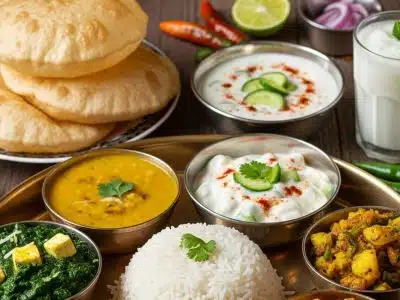
The steel plate arrives with a small clatter, and for a moment nobody at the table touches it. Seven katoris (small steel bowls) sit around a mound of rice, a folded roti steams beside a heap of something green, and a papad leans against the rim as if waiting its turn. You did not order seven dishes; you ordered one meal, and the kitchen has already decided what it should contain.
Travel a few hundred kilometres in any direction and the same word brings a different plate. In Kolhapur it carries two rassas, one fiery red and one pale and creamy. In Guwahati the meal traditionally opens with a khar made from raw papaya and closes with something sour. In Chennai it often lands on a banana leaf, with no bowls in sight. This guide walks through ten regional thalis, explains why each looks the way it does, and shows you how to assemble a balanced one at home.
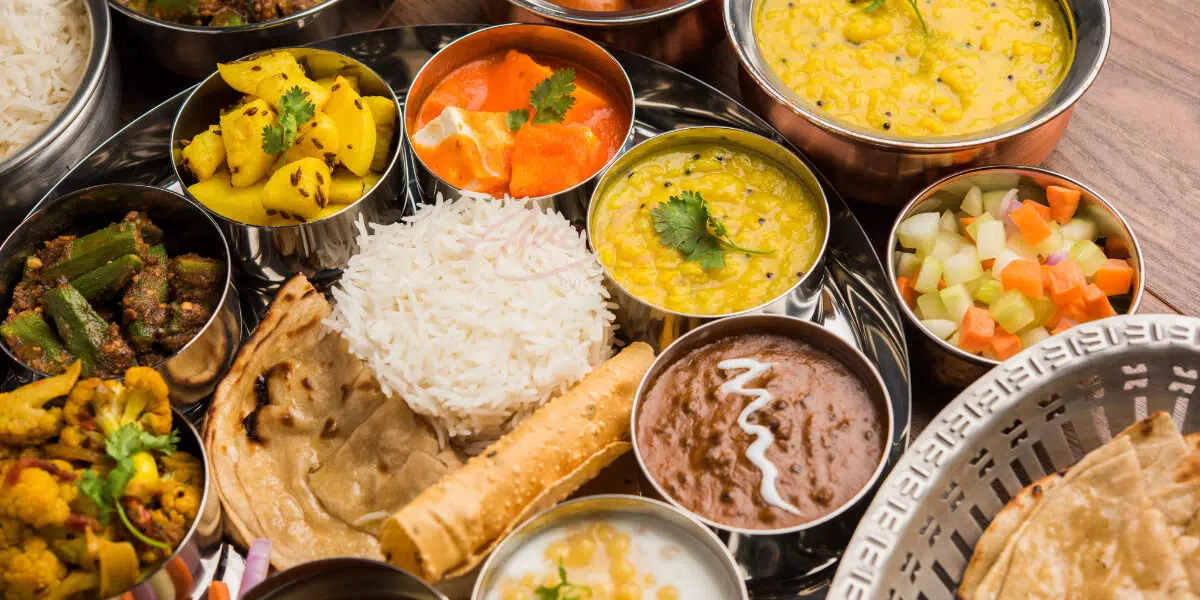
Table of Contents
Key Takeaways
- A thali is a complete meal served as small portions on one plate, usually including a grain, a dal, vegetables, a cooling or sour side, a pickle and a sweet.
- Each regional thali is built around the local staple, such as wheat in Punjab, bajra in Rajasthan and Saurashtra, and rice in Bengal, Assam, Goa and the south.
- Serving order is part of the design, because a traditional Bengali meal moves from bitter to sweet and a South Indian leaf meal commonly ends with curd rice.
- The balance of a thali comes from proportion, so a plate with many bowls can still be a rice-heavy meal.
- National estimates now track the cost of a home-cooked thali month by month.
- A balanced home thali includes one grain, one dal, one dry vegetable, one gravy vegetable, one raw item, curd and a pickle.
Why Does the Thali Matter Right Now?
The thali matters because it is a long-standing model of a balanced Indian meal, and national nutrition guidance has begun to say so openly. An FSSAI blog post on the Dietary Guidelines for Indians describes the ICMR-NIN My Plate for the Day as a plate displayed visually as a thali.
What Is a Thali?
A thali is a round metal plate on which a full Indian meal is served in small portions, and the word also names the meal itself. The portions sit together so the eater can mix them in any order, taking a little dal with rice, a little pickle with bread and a spoon of sweet whenever the mood arrives.
A thali is a round plate, made of metal such as steel, brass or silver, that holds a complete Indian meal as a set of small portions. The word also names the meal, which typically includes a grain or bread, a lentil dish, one or more vegetables, a sour or cooling side, a pickle or chutney, and a sweet.
The word is usually traced to the Sanskrit sthali, a vessel, which fits the idea that the plate, rather than any single dish, is the unit of the meal. The katoris keep wet dishes from running into dry ones.
What Are the Types of Thali in India?
India has no single thali, because every region builds the plate around its own staple grain, cooking fat and souring agent. The table below gives the quick view of ten regional thalis, and the sections after it explain what each plate holds and why.
| Thali | Staple | Signature dishes | Sweet or closing |
| Maharashtrian | Wheat poli, rice | Varan-bhaat, batata bhaji, koshimbir, amti | Puran poli, shrikhand, basundi |
| Kathiawadi | Bajra rotla | Sev tamatar, ringan no olo, kadhi, lasan chutney | Jaggery with ghee, chaas |
| Rajasthani | Bajra, wheat | Dal baati, gatte ki sabzi, ker sangri | Churma |
| Goan | Rice, poi | Fish curry, sorpotel, vindaloo | Bebinca |
| Punjabi | Wheat roti, naan, kulcha | Dal makhani, shahi paneer, pindi chole | Kheer, lassi |
| Kashmiri | Rice | Haak, dum aloo, rogan josh | Phirni, kahwa |
| Bhojpuri | Wheat, sattu | Litti chokha, dal, kadhi bari | Thekua, malpua |
| Bengali | Rice | Shukto, cholar dal, machher jhol | Mishti doi, payesh |
| Assamese | Rice | Khar, masor tenga, aloo pitika | Pitha, tamul paan |
| South Indian | Rice | Sambar, rasam, kootu, poriyal | Payasam |
What Goes on a Thali in Western India?
Western India gives you four very different plates in a short span, including the wheat-and-dal thali of Maharashtra, the bajra-and-buttermilk plate of Saurashtra, the baked and ghee-soaked meal of Rajasthan and the rice-and-fish plate of Goa.
Maharashtrian thali
The everyday Maharashtrian plate begins with plain varan, a toor dal cooked until soft, spooned over hot rice with ghee and a squeeze of lemon. Around it sit items such as a dry batata bhaji, a koshimbir (a raw salad of cucumber or carrot with crushed peanuts and curd), a wedge of pickle and soft wheat polis, the local word for chapati. Festival plates add puran poli, a flatbread stuffed with sweet chana dal and jaggery, and in Kolhapur the thali carries two rassas, the red tambda and the pale pandhra. Our guide to Maharashtrian food goes through the state’s dishes region by region.
Kathiawadi thali
Saurashtra cooks for hot, dry country, and the plate shows it. A thick bajra rotla, flattened by hand and cooked on a clay tawa, stands in for rice and arrives smeared with ghee. It is eaten with ringan no olo, smoky roasted aubergine mashed with onion and garlic, alongside a raw lasan (garlic) chutney that you feel at the back of the throat. Sev tamatar, a tomato curry topped with crunchy sev, and a glass of spiced chaas complete the meal, with jaggery and ghee as the sweet.
Rajasthani thali
Dal baati churma is the plate most often associated with Rajasthan, and its three parts have a clear logic. Baati is a hard wheat ball baked until the crust cracks, then broken open and soaked in ghee. It comes with a dal made from several lentils, and churma is baati crushed and mixed with ghee and jaggery to become the sweet. Where water is scarce, Rajasthani cooks lean on dried and preserved ingredients such as ker sangri (desert berries and beans), gatte (steamed gram flour dumplings simmered in a yogurt gravy) and bajra rotis.
Goan thali
A Goan plate often centres on rice and fish curry, a pairing so common that Konkani speakers shorten it to xit kodi, meaning rice and curry. The curry gets its sourness from kokum or tamarind and its richness from ground coconut. Pork lovers add sorpotel, a spiced and vinegared stew, and vindaloo, a vinegar-and-garlic dish with Portuguese roots. Bebinca, a layered coconut and egg pudding, closes the plate.
What Does a Thali Look Like in Northern India?
A northern Indian thali is built around wheat bread, thick gravies and dairy, with the Punjabi plate as the best known example and the Kashmiri plate as the rice-based outlier.
Punjabi thali
The classic Punjabi winter plate pairs sarson da saag (a slow-cooked mustard greens dish) with makki di roti, a cornmeal flatbread that cracks at the edges and tastes of the griddle. The year-round thali brings dishes including dal makhani, often simmered for hours until the lentils turn glossy and thick, shahi paneer in a cashew-and-cream gravy, pindi chole in a dark spiced base and tandoor-baked naan or kulcha to scoop them up. A glass of lassi, thick enough to need a spoon, and a bowl of kheer round it off.
Kashmiri thali
The everyday Kashmiri meal is usually centred on rice, and the dishes are mild, aromatic and carefully layered. Haak, a leafy green related to collards, is cooked simply with mustard oil and whole red chillies. Dum aloo, baby potatoes fried and then simmered with fennel and ginger, sits next to rogan josh, a mutton curry that gets its red colour from mild Kashmiri chillies and not from heat. A bowl of phirni, a ground-rice pudding set in a clay dish, finishes the plate. The wazwan, the multi-course wedding feast, is a ceremonial meal and a separate subject from the daily thali.
What Is on a Thali in Eastern and North-Eastern India?
Eastern and North-Eastern thalis are rice-based, fish-friendly and sequenced with care, so the order of dishes matters as much as the dishes themselves.
Bhojpuri thali
The Bhojpuri plate, from the Bhojpur belt of Bihar and eastern Uttar Pradesh, is built around litti chokha. Litti is a wheat dough ball stuffed with roasted sattu (ground roasted gram) spiked with seasonings such as ajwain, pickle masala and mustard oil, baked until the crust darkens and then dunked in ghee. Chokha is a mash of roasted aubergine, tomato or potato with seasonings including raw mustard oil, onion and green chilli, and the smoke from the roasting gives chokha its character. Thekua, a crisp wheat-and-jaggery sweet, closes the meal. Our guide to Bihar food covers the wider cuisine.
Bengali thali
The traditional Bengali thali moves in a deliberate sequence. A bitter dish such as shukto opens the meal, dal and fried vegetables (bhaja) follow, then fish in a thin mustard or turmeric jhol, then mutton or chicken, then a sweet-sour chutney, and finally mishti doi or payesh. Cholar dal, made with split Bengal gram and coconut slivers, is a dal often served at celebrations. Our full Bengali thali guide covers the rest.
Assamese thali
An Assamese meal traditionally opens with khar, a dish named for the alkaline liquid made by filtering water through ash of dried banana peel, which is used to cook raw papaya, pulses or fish. It ends with tenga, a light sour curry of fish and tomato or lemon. In between come aloo pitika (mashed potato with seasonings including raw mustard oil, onion and chilli), steamed rice and a leafy green. Tamul paan, areca nut with betel leaf, closes the meal. The sequence runs from alkaline and bitter to sour, so the plate rewards a slow eater.
What Does a South Indian Thali Include?
A South Indian thali, often called a meals or oota, is rice-led and, in many homes and restaurants, served in a set order on a banana leaf. It includes sambar, rasam, vegetable dishes such as poriyal and kootu, curd, a pickle, a papad and a payasam, and the sequence matters because each liquid is eaten with a fresh round of rice.
South Indian thali
In many places, salt, pickle and a dry poriyal or thoran sit at the top of the leaf before the rice arrives. A common sequence is a first round of rice with ghee and sambar, the second is rice with rasam, and the third is curd rice, which signals the end of the meal. The payasam arrives mid-meal or at the end, depending on the state and the occasion. Hot rice releases a faint grassy scent from the leaf. The South Indian food guide covers the four states in more depth.
How Much Does a Home-Cooked Thali Cost in India?
Crisil Intelligence estimated that a home-cooked vegetarian thali cost Rs 29.5 in August 2026, up 1 per cent on the year, while a non-vegetarian thali cost Rs 57.5, up 5 per cent. The figure is built from input prices for the ingredients, not from restaurant menus, so it describes what the plate costs to make at home.
Crisil Intelligence estimates that a home-cooked vegetarian thali cost Rs 29.5 in August 2026, up 1 per cent on the year, and a non-vegetarian thali cost Rs 57.5, up 5 per cent. Source: Crisil Intelligence, RRR: Roti Rice Rate, September 2026
Crisil defines the vegetarian thali as roti, vegetables (onion, tomato and potato), rice, dal, curd and salad. The non-vegetarian version replaces the dal with broiler chicken. Because onion, tomato and potato are named inputs, a price spike in those three feeds straight into the number.
The Economic Survey 2019-20 reported that a vegetarian thali became 29 per cent more affordable and a non-vegetarian thali 18 per cent more affordable for an average worker between 2006-07 and 2019-20. Source: Ministry of Finance, Economic Survey 2019-20, Volume 1, Chapter 11 (Thalinomics)
A chain of reasoning runs through both figures, in which input prices move the cost of the plate, the cost of the plate moves a household’s budget, and the budget shapes what people eat. The first link is measured directly. The later links are inferences, because the Survey built its thali on the National Institute of Nutrition’s 2011 guideline quantities for a heavy-work adult male, priced it with consumer price index data for industrial workers, and does not observe what any household actually cooks. Crisil’s non-vegetarian figure also depends on estimated broiler prices. What the evidence shows is the movement in the cost of a standard plate over time, and it leaves open whether people in fact eat that plate.
Is a Thali Actually Balanced?
A thali is balanced only when the proportions are right, and ICMR-NIN data suggest that many Indian plates lean heavily towards grain. In the What India Eats report, cereals supply 51.4 per cent of energy for urban adults and 65.2 per cent for rural adults, against a recommended maximum of 45 per cent.
The ICMR-NIN What India Eats report found that cereals supply 51.4 per cent of dietary energy for urban adults and 65.2 per cent for rural adults, compared with a recommended maximum of 45 per cent. Source: Hemalatha R and colleagues, What India Eats, ICMR-National Institute of Nutrition, 2023
The costed thali in the Economic Survey and the NIN My Plate for the Day point in the same direction when you put them side by side. The costed plate is heavier on cereal and lighter on vegetables, which suggests that a thali built to a budget may lean on grain, although the two documents use different reference diets.
| Food group | Economic Survey 2019-20 costed thali | NIN My Plate (2,000 kcal) |
| Cereals | 300 g | 250 g |
| Pulses (dal) | 60 g | 85 g |
| Vegetables | 150 g | About 400 g |
The two documents use different reference diets (a heavy-work adult male in the Survey, a 2,000 kcal day in My Plate), so the table is best read for direction only. Sources: Economic Survey 2019-20 and NIN My Plate for the Day.
A plate with seven katoris can still be a rice meal, because the bowls count for less than the proportions between them.
How Do You Build a Balanced Thali at Home?
Build a home thali from seven parts, including one grain, one dal, one dry vegetable, one gravy vegetable, one raw item, curd and a pickle. Let vegetables and salad take up about half the plate, in line with the NIN My Plate, and let the grain and the dal share the rest.
- Pick one grain for the day, whether rice, roti or a millet bread such as bajra or jowar, and keep the portion modest so the vegetables have room.
- Cook a dal that suits the grain, such as a thin toor dal with rice or a thicker moong with roti, and finish it with a tadka (spices bloomed in hot ghee or oil until the mustard seeds pop).
- Make two vegetables with different textures, one dry and one with gravy, and use seasonal vegetables, which usually keeps the cost down.
- Add something raw, such as sliced cucumber, onion and tomato with lemon, and a katori of curd.
- Finish with a pickle or chutney for sharpness, and a small sweet only if the day calls for it.
Three mistakes are easy to make. The first is filling the plate with rice and treating the vegetables as garnish, which brings the proportion back to the cereal-heavy pattern described above. The second is serving only gravies, so every bite has the same softness. The third is skipping the raw item, when a cucumber and a lemon take less time than the tadka.
Cook the dal first. It tolerates waiting, and the rest of the plate does not.
If you are planning thalis around a budget or a health condition, our guide to a diabetes-friendly thali on a budget shows how to adjust portions without adding cost.
Start With Two Katoris
Pick the thali from this list that sits furthest from what you normally cook and make only two parts of it this weekend, such as the dal and one vegetable. Put them in katoris, add rice or roti, and notice how the plate changes what you reach for first.
Frequently Asked Questions
What is a thali in Indian food?
A thali is a meal served as several small portions on a single plate. Most plates include a grain or bread, dal, one or two vegetables, curd, a pickle and a sweet.
How many items are in a thali?
There is no fixed number. A modest home thali may hold four or five components, while a festive or restaurant thali can run well past ten.
What is the difference between a North Indian and a South Indian thali?
A North Indian thali centres on wheat breads with thick, dairy-rich gravies, while a South Indian thali centres on rice with sambar, rasam and coconut-based vegetables.
Is a thali healthy?
The ICMR-NIN My Plate for the Day gives vegetables and fruit about half of the plate, so a thali fits that pattern when vegetables take up more room than rice or roti. The What India Eats data show that grain supplies a large share of energy in real diets, which makes the proportions on your own plate the part you can control.
Which regional thalis are mostly vegetarian?
Everyday plates including the Rajasthani, Kathiawadi and Maharashtrian thalis are largely vegetarian, as is the vegetarian meals plate served in many South Indian restaurants. Bengali, Goan and Assamese thalis often centre on fish, and Punjabi and Kashmiri thalis come in both vegetarian and meat versions.
Sources & Further Reading
- Crisil Intelligence. RRR: Roti Rice Rate, Crisil Intelligence, September 2026. https://intelligence.crisil.com/content/dam/crisil-intelligence/what-we-think/reports/2026/09/roti-rice-rate-september2026.pdf
- Ministry of Finance, Government of India. Economic Survey 2019-20, Volume 1, Chapter 11, Thalinomics: Economics of a Plate of Food in India, 2020. https://www.indiabudget.gov.in/budget2020-21/economicsurvey/doc/vol1chapter/echap11_Vol1.pdf
- Hemalatha R and colleagues, ICMR-National Institute of Nutrition. What India Eats, 2023. https://www.nin.res.in/nutrition2020/what_india_eats.pdf
- ICMR-National Institute of Nutrition. My Plate for the Day (English poster), 2023. https://www.nin.res.in/downloads/My plate for the day-english-09-10-2023.pdf
- Mathur P. Eating Healthy is a Balancing Act – Key Take-Aways from the Dietary Guidelines for Indians, FSSAI Blogs, 2024. https://blogs.fssai.gov.in/blog/10

Good