
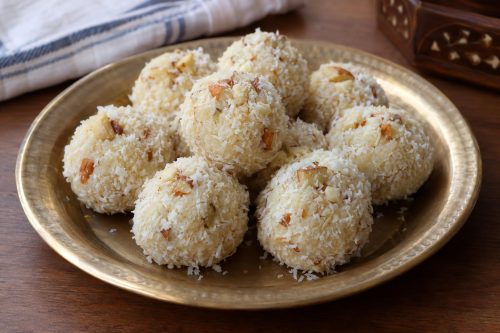
Coconut Laddu is one of the more easy to create Indian sweets to make at home. The entire recipe depends on two main ingredients, condensed milk and desiccated coconut, cooked together until the mixture pulls away from the pan. Cardamom powder adds fragrance, and a handful of mixed nuts gives each laddu a little texture on top. Because there is no sugar syrup to manage and no deep frying involved, this is a genuinely easy laddu recipe that even a first-time sweet maker can follow with confidence. The result is a soft, mildly sweet ball with a coconut coating that holds its shape well once cooled.
About the Recipe
The recipe uses condensed milk as both the sweetener and the binding agent, which removes the need for separately measured sugar or jaggery. Only one and a half cups of desiccated coconut go into the pan; the remaining half cup is kept aside for rolling. The mixture must be stirred without stopping from the moment it goes on the heat. Once it thickens and stops sticking to the pan, it is ready to shape. Shaping must happen while the mixture is still warm, as it firms up quickly on cooling and becomes difficult to roll smoothly.
Why You Will Love This Recipe
The reason to make this particular coconut laddu recipe is how little can go wrong when you follow the pan cues correctly. There is no temperature probe needed, no syrup thread test and no oven to preheat. The mixture tells you exactly when it is ready by pulling cleanly away from the pan sides. The second reason is the short ingredient list. Condensed milk, desiccated coconut, cardamom powder and a few nuts are all that stand between you and a plate of finished laddus. For anyone who has found other Indian sweets technically demanding, this is a reliable place to start.
Cooking Tips
The most common beginner mistake is leaving the heat too high, which causes the condensed milk to catch and brown unevenly before the coconut is fully incorporated. Keep the flame at medium throughout. Never stop stirring, even briefly, once the mixture is in the pan. Shape the laddus while the mixture is still warm to the touch. If it cools completely before you finish rolling, the mixture cracks rather than forming a smooth ball.
Top Tips
- Use a heavy non-stick pan so the condensed milk heats evenly and does not stick before the coconut absorbs it.
- Add the cardamom powder only after the mixture has thickened, not at the start, so the fragrance is not cooked off.
- Work quickly when shaping. Divide the mixture into portions first, then roll each one, rather than rolling one at a time from the pan.
- Lightly grease your palms with a small amount of ghee before rolling if the mixture is sticking to your hands.
- Press the chopped nuts gently into the top of each laddu rather than mixing them in, so they stay visible as a garnish.
- The reserved half cup of desiccated coconut for rolling should be at room temperature and completely dry so it coats evenly.
Serving and Storing Suggestions
Serve coconut laddu at room temperature on a plate or in small paper cups. They work well as part of a festival spread alongside other Indian sweets. Store in an airtight container at room temperature for up to two days, or refrigerate for up to five days. If refrigerated, allow them to sit at room temperature for ten minutes before serving, as they firm up considerably when cold. Do not stack them in the container without a layer of parchment between rows, as the coconut coating transfers.
Similar Recipes
Nutrient Benefits
Desiccated coconut provides dietary fibre and contributes to the overall fat content of each laddu. Condensed milk supplies calcium and some protein. Mixed nuts such as almonds, cashews and walnuts add small amounts of protein, healthy fats and minerals including magnesium and zinc. Cardamom contributes trace minerals. These laddus are energy-dense, so a small serving of one or two pieces is typically enough as a sweet at the end of a meal.
Coconut Laddu
Ingredients
- 1 cup Condensed Milk
- 2 cup Desiccated Coconut
- as required Cardamom Powder
- as required Mixed Nuts (Almonds/Cashews/Walnuts) chopped or broken
Instructions
- Heat a non stick pan in medium flame.
- Add the condensed milk and 1 1/2 cup coconut to it.
- Keep stirring continuously.
- When the mixture is thickened, add the cardamom powder and mix well.
- Keep stirring until the mixture is not sticking to the pan.
- Remove from flame and transfer the content to another dry plate.
- Keep the remaining 1/2 cup coconut in a plate.
- Make small balls of laddu when it is little hot.
- Roll over the balls in the coconut.
- Garnish with nuts and serve.
Recipe Video
Sign up for our newsletter
Add Awesome Cuisine as a Preferred Source

Frequently Asked Questions
Can I use fresh grated coconut instead of desiccated coconut?
Fresh grated coconut has a much higher moisture content than desiccated coconut, which changes how the mixture cooks and thickens. The mixture will take considerably longer to dry out, and the finished laddus may not hold their shape as well or last as long at room temperature. Desiccated coconut is specifically suited to this recipe because it absorbs the condensed milk quickly and produces a mixture that sets firmly enough to roll. If you do use fresh coconut, expect to stir for longer and refrigerate the finished laddus rather than storing them at room temperature.
How do I know when the mixture is ready to take off the heat?
The mixture is ready when it pulls away cleanly from the sides and base of the pan as you stir and does not leave a wet residue behind. It will look noticeably drier and feel heavier on the spatula than when you started. If you press a small amount between your fingers and it holds together without feeling wet or sticky on the surface, it is ready. Do not wait until it looks completely dry in the pan, as residual heat will continue to firm it up once removed from the flame.
What nuts work best for garnishing, and can they be mixed into the laddu instead?
Almonds, cashews and walnuts all work well. Cashews are the mildest in flavour and complement the coconut without overpowering it. Almonds add a firmer bite. The recipe uses nuts as a garnish pressed onto the outside of each laddu rather than mixed into the dough, which keeps the texture of the laddu itself smooth and consistent. You can mix finely chopped nuts into the mixture before shaping if you prefer, but larger pieces may make rolling uneven.
The mixture cooled before I finished shaping. Can I reheat it?
Yes, you can return the mixture to the pan on a very low flame for a minute or two, stirring constantly, to warm it enough to become pliable again. Be careful not to add any liquid and do not leave it unattended, as it can catch on the pan quickly at this stage since most of the moisture has already been cooked out. Alternatively, lightly greasing your palms with ghee and working quickly can help you shape a cooled mixture without reheating.
Can this coconut laddu recipe be made without condensed milk?
Condensed milk is the binding and sweetening agent in this particular recipe, so removing it changes the recipe substantially. Some versions of coconut laddu use sugar syrup cooked to a specific consistency, or jaggery dissolved and reduced, as a substitute binder. Those methods require more careful monitoring of the syrup stage and produce a slightly different texture and flavour. If you need a version without condensed milk, refer to a recipe written specifically for that approach rather than adapting this one, as the ratios and technique differ.
Hi,
You can use fresh coconut to make this laddoo.