
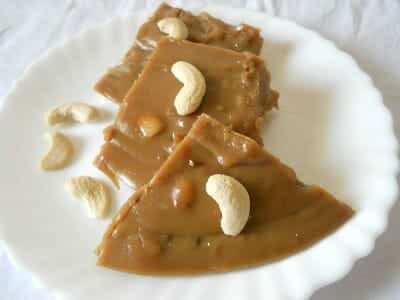
Goan Dodol is one of those sweets that reminds you why patience matters in the kitchen. This traditional Goan dessert combines rice flour, coconut milk, and jaggery into a rich, chewy confection that takes some stirring but rewards you with deep, caramel like flavor. The process is simple but requires your attention as the mixture thickens and makes.
You will know it is ready when the dodol pulls away from the pan and releases its coconut oil. The nuts add a satisfying crunch to each bite. It keeps well for several days, which makes it handy for gifting or enjoying slowly over time.
About the Recipe
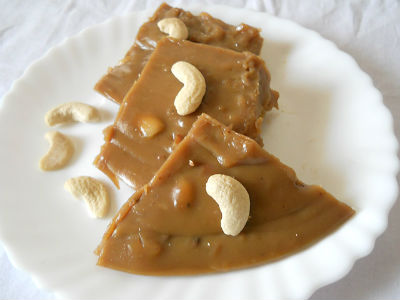
This recipe brings together just a handful of ingredients to create something genuinely special. The combination of thick and thin coconut milk gives the dodol its characteristic richness without becoming too heavy. Jaggery lends a warm, molasses like sweetness that white sugar merely cannot match. The texture falls somewhere between fudge and toffee, soft enough to bite but firm enough to hold its shape.
Because the ingredient list is short, each component really shines through. It is a wonderful way to experience traditional Goan flavors at home, and the recipe scales easily if you want to make a larger batch for holidays or gatherings.
Why you will love this recipe
The beauty of Goan Dodol lies in how it balances sweetness with the natural richness of coconut. Unlike overly sugary treats, this dessert has a mellow, caramel depth that comes from slowly cooking the jaggery. The texture is wonderfully chewy without sticking to your teeth, and the chopped almonds or cashews provide little bursts of crunch.
I like to stir mine over medium heat because it gives me better control as the mixture thickens. The recipe does ask for continuous stirring, but the process becomes almost meditative once you settle into it. You can see and smell the transformation as the dodol darkens and releases its aroma, which makes the effort feel worthwhile.
Cooking Tips
Keep your heat at medium to prevent the bottom from scorching, and use a heavy bottomed pan if you have one. Stir continuously once the mixture begins to thicken because it can stick quickly. Add the jaggery in two stages as the recipe suggests, which helps it dissolve evenly and prevents clumping. If your mixture seems too thick, you can add a tablespoon of thin coconut milk to loosen it slightly.
Watch for the moment when oil rises to the surface and the dodol pulls cleanly from the sides. That is your signal to remove it from the heat. Grease your dish lightly before pouring so the cooled dodol lifts out easily.
Serving and Storing Suggestions
This recipe yields about 15 to 20 small pieces, depending on how you cut them. Prep and cook time together take roughly 45 minutes, with most of that spent stirring. Serve the dodol at room temperature, either as a standalone sweet or alongside strong coffee or tea. Store the pieces in an airtight container at room temperature for up to a week, or refrigerate for slightly longer storage.
Because the texture firms up when cool, you might want to let refrigerated pieces sit at room temperature for a few minutes before serving. The dodol also makes a thoughtful gift when wrapped in parchment or packed in small tins.
Similar Recipes
- Coconut Barfi
- Mysore Pak
- Bebinca
- Karanji
- Nankhatai
Goan Dodol
Ingredients
- Coconut Milk (1/2 cup thick + 1/2 cup thin)
- 60 to 75 gms Rice Flour
- 115 gms Jaggery
- 30 gms Almonds or Cashews (blanched, chopped)
- Salt as per taste
Instructions
- Mix the rice flour with thin coconut milk.
- Transfer to a pan, add salt and bring to a boil.
- Add half the jaggery and continue to boil.
- Keep stirring.
- As soon it starts to thicken, add the remaining jaggery and continue to stir.
- Now add the thick coconut milk and continue to boil.
- Continue to stir and add the almonds.
- When it starts to leave the sides of the pan and oil rises to the top, remove and pour into a flat dish.
- Spread evenly and cool.
- Cut into desired shapes and serve.
Sign up for our newsletter
Add Awesome Cuisine as a Preferred Source

Frequently Asked Questions
Can I use brown sugar instead of jaggery?
Yes, you can substitute brown sugar if jaggery is hard to find. However, jaggery gives a deeper, more complex flavor with hints of molasses. If using brown sugar, the dodol will still turn out well but taste a bit different.
Why does my dodol stick to the pan?
Sticking usually happens when the heat is too high or stirring is not frequent enough. Keep the flame at medium and stir continuously once the mixture starts to thicken. A heavy bottomed pan also helps distribute heat more evenly.
How do I know when the dodol is ready?
The dodol is done when it pulls away cleanly from the sides of the pan and you see a thin layer of oil rising to the surface. It should hold together when you scrape the spoon through it and not flow back immediately.
Can I make this without nuts?
Without a doubt. The nuts add texture but are not essential to the recipe. Merely leave them out if you prefer or if you have a nut allergy. The dodol will still have its characteristic chewy texture and rich flavor.
How thin should the coconut milk be?
Thin coconut milk is what you get when you add water to grated coconut and squeeze it a second time, or when you dilute canned coconut milk with equal parts water. Thick coconut milk is the first press or undiluted canned milk. If using canned, reserve half as is and dilute the other half.
image credit: flavors of mumbai



1 comment
Good morning and Merry Christmas,
I was wondering whether you could direct me to any website or resource which details preparation of Goan sweets (Kuswar) by the microwave method.
Most Goan sweets, especially toffees (almond, walnut etc.) are labour intensive requiring hours of stirring on the stove till they are ready. I have tried with great success preparing Doce De Grao (Gram Dal Sweet) by the microwave method which dramatically reduces cooking time.
I realize that certain sweets like Kul Kuls have to be prepared by the traditional way but I was looking for microwave options for preparing Dodol, for example, where there is stirring on the stove involved.
Any feed back that you can provide will be gratefully appreciated.
Kind regards
Bernard Alvares