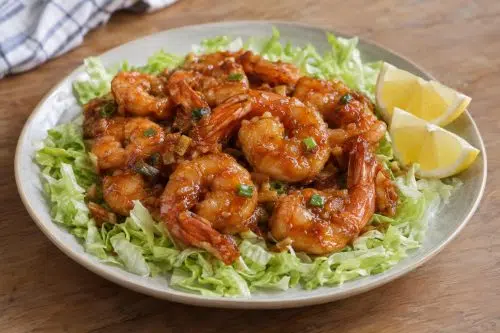
Prawns with Hot Bean Sauce is a straightforward Chinese-style prawn dish that delivers a lot of flavour without a long list of complicated steps. The prawns are first coated in an egg white and cornstarch marinade, deep-fried at a controlled temperature, and then finished in a wok with a sauce that combines ketchup, hot bean sauce, rice wine and aromatics. The sauce is thickened with cornstarch so it coats the prawns evenly rather than pooling at the bottom of the plate. Served over shredded lettuce with lemon wedges, it makes a clean, bright presentation.
About the Recipe
The egg white in the marinade keeps the prawns tender during frying, while the cornstarch forms a thin shell that holds the sauce later. The prawns are fried at around 300F, which is lower than a typical deep-fry temperature. Prawns cook quickly, and a higher heat would toughen them before they pick up colour.
The sauce is mixed in advance and added all at once, so the wok stays hot and the cornstarch thickens the sauce in seconds. Similar prawn dishes follow the same fry-then-sauce method.
Why You Will Love This Recipe
The sauce is genuinely well-balanced. Ketchup brings body and a mild sweetness, hot bean sauce adds heat and depth, and rice wine cuts through both with a clean, slightly sharp note. None of these flavours dominates.
Because the cornstarch slurry is stirred in at the end, the sauce thickens quickly and coats each prawn in a glossy layer. The shredded lettuce underneath is not just garnish. It absorbs some of the sauce and gives a cool, crunchy contrast to the warm prawns, which makes the whole dish more interesting to eat.
Cooking Tips
The most common mistake is overcooking the prawns during the initial fry. Pull them out as soon as they change colour. They will finish cooking when returned to the wok with the sauce.
Keep the oil at around 300F rather than letting it climb higher. If the cornstarch slurry sits for a few minutes, it will settle, so give it a quick stir just before adding it to the wok. Have all the sauce components measured and ready before the oil goes on.
Top Tips
- Pat the prawns completely dry before mixing in the marinade. Excess moisture stops the egg white and cornstarch from adhering properly.
- Do not skip the 30-minute marinade. It is what keeps the prawns soft after frying.
- Mix the sauce ingredients in one bowl before you start cooking so you can add everything in one go when the wok is hot.
- Stir the cornstarch and water mixture again just before adding it to the sauce. It settles quickly.
- Leave only about 2 tablespoons of oil in the wok after frying. Too much oil will make the sauce greasy rather than glossy.
- Taste the sauce before adding salt and sugar. The hot bean sauce and ketchup both carry salt, so adjust carefully.
Serving and Storing Suggestions
Serve the prawns immediately over shredded lettuce with lemon wedges on the side. The lettuce wilts quickly once the hot prawns are placed on top, so plate just before serving.
This dish does not store well because the coating softens and the lettuce collapses. If you need to prepare ahead, keep the fried prawns and sauce separate, then combine them in the wok just before serving. Steamed rice or plain noodles work well alongside.
Similar Recipes
- Prawns in Spicy Coconut Sauce
- Coconut Prawns with Cucumber Salad
- Jewel Prawns
- Shrimp with Tomato Sauce
- Fish in Spicy Sauce
Nutrient Benefits
Prawns are a good source of protein and relatively low in fat. Egg white in the marinade adds a small amount of additional protein. The dish is light on carbohydrates, with only a small quantity of cornstarch used across the marinade and sauce. Lettuce adds some fibre and water content to the meal.

Prawns with Hot Bean Sauce
Ingredients
- 500 gms, peeled and deveined Prawns
- Marinade
- 1 Egg White
- 1 tsp Salt
- 1 tblsp or as required Cornstarch
- Sauce
- 4 tblsp Ketchup
- 1 tblsp Hot Bean Sauce
- 1 tblsp Chinese Rice Wine or Dry Sherry
- 1 tblsp Chicken Broth or Water
- 1 tsp Cornstarch
- 2 tblsp Water
- 1/2 , chopped Green Onion
- 1 tblsp, finely chopped Ginger
- 4 cups Oil for deep frying
- Salt - to taste
- Sugar - to taste
- 3 to 4, shredded Lettuce leaves
- 2 , cut into wedges Lemons
Instructions
- Rinse the prawns under warm running water and pat dry. Leave whole or cut in half lengthwise if desired.
- Use your fingers to mix in the marinade ingredients. Marinate the prawns for 30 minutes.
- In a small bowl, mix together the sauce ingredients. Set aside.
- In another small bowl, dissolve the cornstarch in 2 tblsp water. Set aside. Chop the green onion and ginger.
- Heat the oil in a wok to about 300F. When the oil is hot, add the marinated prawns.
- Deep fry until they change colour and are nearly cooked. Remove from the wok with a slotted spoon and drain.
- Leave all but 2 tblsp oil in the wok and remove the rest.
- Add the ginger and green onion and stir-fry until aromatic. Add the sauce ingredients. Give the cornstarch and water mixture a quick re-stir and add to the sauce, stirring quickly to thicken.
- Add the prawns back into the wok. Sprinkle the salt and sugar over top.
- Serve the prawns on top of the torn lettuce leaves with lemon wedges for garnish.
Sign up for our newsletter
Add Awesome Cuisine as a Preferred Source

Frequently Asked Questions
Can I use dry sherry instead of Chinese rice wine?
Yes. The recipe lists dry sherry as a direct substitute for Chinese rice wine and the quantity stays the same. Both add a mild alcoholic sharpness that balances the sweetness of the ketchup. Avoid cooking wine sold in bottles labelled as such, as these often contain added salt.
What is hot bean sauce and where can I find it?
Hot bean sauce is a fermented paste made from chillies and soybeans. It is sold in jars at most Asian grocery stores, often labelled as chilli bean sauce or doubanjiang. The flavour is salty, spicy and slightly earthy. Only 1 tablespoon is used in this recipe, so a single jar will last through several batches. Store the opened jar in the refrigerator.
My sauce did not thicken properly. What went wrong?
The most likely reason is that the cornstarch slurry was not stirred before adding it to the wok. Cornstarch settles to the bottom of the bowl quickly, so the liquid you pour in may be mostly water with very little starch. Always stir the mixture again just before using it. Also make sure the wok is hot when you add the slurry, as a cool wok will not activate the thickening.
Can I shallow fry the prawns instead of deep frying them?
You can, but the result will be different. Deep frying at around 300F cooks the prawns quickly and evenly on all sides, and the egg white and cornstarch coating sets properly. Shallow frying requires turning the prawns and the coating may not set as evenly. If you prefer to use less oil, pan frying in a single layer with enough oil to come halfway up the prawns is a reasonable compromise, though the texture will be slightly less uniform.
How do I know when the prawns are ready to come out of the oil?
Watch for the colour to change from grey and translucent to pink and opaque. At around 300F this happens in roughly 1 to 2 minutes depending on the size of the prawns. Do not wait for them to look fully cooked at this stage. They will go back into the wok with the sauce and will finish cooking there. Leaving them in the oil too long makes them rubbery by the time they reach the plate.