
Caramel Custard takes me straight back to the school tuck shop where I first had it — served cold in a small steel bowl, wobbling slightly as it was set down. I must have been eleven or twelve. I had no idea then that something so smooth and glossy was made from just milk, eggs, and a bit of burnt sugar. It seemed far too elegant for five rupees.
Years later, I tracked down a simple version and made it in a steel dabba the first time, which worked perfectly well. What I keep coming back to is that specific amber layer at the bottom — the caramel that turns syrupy when you unmould it and runs across the plate. That detail never gets old, no matter how many times I have made this.
About the Recipe
All six ingredients here are everyday pantry staples — milk, eggs, sugar, and vanilla essence. Nothing needs to be sourced specially. The active cooking time is around 15 minutes, and the steaming takes between 30 and 45 minutes on very low heat. I make this when I have guests coming and want a dessert that can be prepared hours ahead and refrigerated. It holds well in the mould until you are ready to serve, which means there is no last minute scrambling in the kitchen when people are already at the table.
Why you will love this recipe
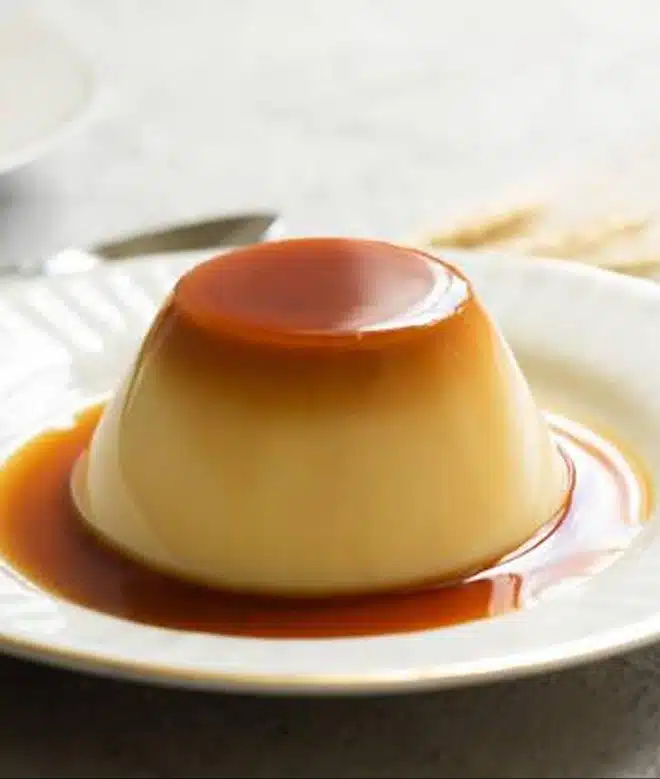
A steamed custard gives you something no baked version quite does — a texture that is just set through but still trembles when you move the plate. The caramel layer is where the real reward is. You cook plain sugar until it darkens to a deep brown, then add water and let it thicken into a glossy syrup that coats the mould.
When you flip the custard after chilling, that syrup runs down the sides in a thin, amber stream with a faint bittersweet edge that cuts through the sweetness of the custard below. This is also a dessert that suits the Indian kitchen well. You do not need an oven, only a covered pot or pressure cooker wide enough to hold the mould. The steam does all the work while you step away. I keep the heat deliberately low — around the lowest flame my burner allows — because that is what gives the custard its smooth, unbroken surface.
Cooking Tips
The most common beginner mistake is rushing the caramel. If you pull it off the heat too early while it is still pale golden, the syrup will taste flat and very sweet. Wait for a deep amber colour — it should smell slightly sharp, almost like toffee on the edge of burning. That is the right moment.
The second thing that trips people up is pouring boiling milk too slowly into the eggs, which can scramble them. Pour it in quickly while beating, and work fast. Any lumps that do form can be strained out through a fine sieve before you pour into the mould.
Top Tips
- Rinse the mould in cold water before pouring the hot caramel in — this slows the caramel from setting too fast and gives you time to swirl it up the sides.
- When you add water to the melted sugar, stand back slightly. It will hiss and spit quite aggressively for a second or two before it settles.
- Steam on the lowest possible heat. A vigorous boil will create bubbles in the custard and leave it pitted rather than smooth on the surface.
- Check doneness with a thin needle or a toothpick pushed into the centre — it should come out completely clean with no liquid clinging to it.
- The custard must be fully cold before you attempt to unmould it. If you try it while still warm, it will not hold its shape on the plate.
- If you have no aluminium foil, grease a thick piece of brown paper well on both sides with butter and use that to cover the mould — it works just as reliably.
Serving and Storing Suggestions
Serves 3 to 4 people. Active prep time is roughly 15 minutes, with 30 to 45 minutes of steaming and at least 2 hours of refrigeration before serving. Unmould directly onto a flat plate with a slight lip so the caramel syrup does not run off the edge. Serve immediately after unmoulding because the syrup begins to be absorbed back into the custard as it sits. Leftovers can be stored in the mould, covered, in the refrigerator for up to 2 days.
Similar Recipes
- Bread Pudding
- Egg Pudding
- Semolina Halwa
- Phirni
- Coconut Milk Pudding
Caramel Custard
Ingredients
For the custard
- 2 cups milk
- 2 eggs
- 2 tablespoons sugar
- 1/4 teaspoon vanilla essence
For the caramel
- 3 tablespoons sugar
- 1/2 cup water
- a deep mould for steaming
Instructions
- Melt the sugar on low heat until it turns a deep brown. Remove from fire, add the water carefully, then put back on fire and cook on slow heat until a thick honey-like syrup is obtained. This is the caramel.
- While still hot, pour the caramel into the mould (rinsed in cold water) and gradually turn the mould so that the sides get coated with the caramel. Leave aside.
For the custard:
- Beat the eggs with the sugar thoroughly.
- Boil the milk. While still boiling, pour into the egg-sugar mixture and beat vigorously until well blended. There should be no lumps.
- Add the essence, beat once again and pour into the mould.
- Cover the mould with a piece of aluminium foil. Bring down the foil on all sides and tie at the rim of the mould with the piece of string.
- Steam cook the custard on very low heat for 30-45 minutes. (A fine needle pierced through should come out clean). Remove the foil. Cool, and refrigerate until ready to serve.
- Just before serving, cover the mouth of the mould with a plate. Quickly turn the mould over on to the plate and remove the mould. Serve immediately.
Note: If you have no aluminium foil, cut a thick brown paper into a circle 5cm larger than the mould. Grease well on both sides with some butter or refined oil.
Sign up for our newsletter
Add Awesome Cuisine as a Preferred Source

Frequently Asked Questions
My caramel hardened the moment I poured it into the mould and I could not swirl it up the sides. What went wrong?
The caramel sets quickly once it hits a cool surface, so speed matters here. Rinse the mould in hot water rather than cold water before pouring, and tilt and rotate the mould the second the caramel goes in — do not wait even a few seconds. If it does set before you can coat the sides, do not worry about it too much. A base coating alone still works and will still give you the syrup layer when you unmould.
The custard came out with a lot of small holes or a spongy texture instead of being smooth. What caused that?
This almost always means the heat was too high during steaming. A fast boil creates steam bubbles that get trapped in the custard as it sets. Keep the flame on its absolute lowest setting and use a heavy bottomed pot that distributes heat evenly. Covering the mould tightly with foil also helps, because it stops condensation from dripping down onto the surface of the custard.
Can I use a pressure cooker instead of a steamer?
Yes, and it works well. Place the covered mould on a small trivet or a folded cloth inside the pressure cooker with about 2 cups of water. Cook without the weight (whistle) on low heat for around 30 minutes. Do not use high heat and do not put the pressure weight on — you are using it as a steaming vessel, not a pressure vessel.
The custard stuck to the mould and would not release cleanly when I turned it over. How do I avoid this next time?
Run a thin knife or a flat spatula gently around the edge of the custard before inverting. This breaks the seal between the custard and the mould wall. Also make sure the custard is thoroughly cold all the way through before you attempt this — a warm custard will stick and tear.
Can I make this without eggs?
The eggs are what set the custard. Without them, you would need a different thickening agent entirely, like cornflour or agar agar, and the result would be a different dessert with a noticeably different texture. For this particular recipe, I would not substitute the eggs out.
ausome!!