
Mangalore Fish Curry earned its place in my regular rotation only after I ruined it twice. The first time, I added the fish too early and it turned to mush before the curry had a chance to develop any depth. The second time, I skipped making the paste from scratch and used a store-bought substitute. The result was flat and vaguely orange, nothing like it should be.
What finally clicked was understanding that the paste is not an add-on — it is the recipe. Once I started making it properly, toasting the whole spices in oil until the kitchen smelled warm and slightly smoky, everything else followed. The thing that keeps me coming back to this dish is that hiss when the onions hit the oil and the way the coconut milk settles into the masala. That moment when you stir it together is when you know it is going to work.
About the Recipe
Most of the ingredients here are pantry staples if you cook Indian food regularly — dry red chillies, coriander seeds, cumin, peppercorns, and tamarind concentrate. The fresh items you need are minimal: one small tomato, one onion, a handful of curry leaves, and fish steaks.
The red masala paste takes about fifteen minutes to make and stores well in the refrigerator for up to three weeks, so you are actually setting yourself up for several meals in one go. I would make this on a weeknight when I want something proper without spending an hour at the stove.
Why you will love this recipe
The red masala paste is the real reason this curry is worth making regularly. Because you prepare it in advance and store it, you are not starting from scratch every time. On a weeknight, the actual curry comes together in about twenty minutes once the paste is ready — onions, tomatoes, coconut milk, fish, and you are done.
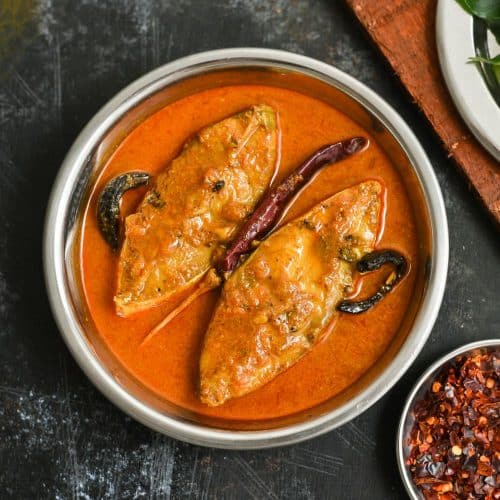
The coconut milk keeps the heat from being sharp, while the tamarind cuts through the richness so the curry does not sit heavy. Pomfret holds up particularly well here because the steaks stay firm through the simmer, but mackerel brings its own stronger flavour that works equally well with the spice level in the paste. Either way, you get a curry with real body and a sauce that is worth spooning over plain rice.
Cooking Tips
The most common mistake is overcooking the fish. Ten minutes on a low flame is enough — if you go beyond that, the pieces break apart when you try to serve them. Keep the flame genuinely low once the fish goes in. The second thing that trips beginners up is grinding the masala paste with too much water at once.
Add the quarter cup gradually so the paste stays thick rather than watery. A watery paste will thin your curry more than you want.
Top Tips
- Make the red masala paste a day ahead and refrigerate it overnight — the flavour deepens slightly and it saves you time on the day you cook.
- Use fish steaks rather than fillets here. Steaks hold their shape during the simmer because the bone runs through the centre and keeps the flesh intact.
- Do not let the coconut milk boil hard for more than a minute or two. A rolling boil can cause it to split and look grainy, so bring it to a gentle boil and then lower the flame immediately.
- If you are using mackerel, rinse the steaks well and pat them completely dry before adding to the curry. Mackerel releases more moisture than pomfret, which can dilute the sauce.
- The leftover masala paste keeps for up to three weeks in the refrigerator in an airtight glass jar. Use it in prawn curries or as a base for vegetable gravies.
Serving and Storing Suggestions
Serves 2 to 3 people. Preparation and cooking time is about 40 minutes in total, including making the paste from scratch. Serve the curry hot with plain steamed rice — the sauce is thin enough to need something to soak into. Store any leftovers in a covered container in the refrigerator for up to two days.
Reheat on a low flame and add a small splash of water if the sauce has thickened overnight. Do not freeze this curry as the coconut milk separates on thawing.
Similar Recipes
- Goan Fish Curry
- Kerala Fish Molee
- Chettinad Fish Kuzhambu
- Coconut Prawn Curry
- Malabar Fish Curry
Nutrient Benefits
Fish steaks — whether pomfret, mackerel, or kingfish — are a good source of protein and omega-3 fatty acids, which support heart and brain health. Mackerel in particular is one of the richer sources of omega-3 among commonly available fish in India.
Coconut milk adds medium-chain fatty acids, and the whole spices in the paste — coriander, cumin, and peppercorns — have long been used in Indian cooking for their digestive properties. The tamarind contributes a small amount of iron and tartaric acid, which aids digestion.

Mangalore Fish Curry
Ingredients
- 375 gms Fish Steaks - washed, dried (pomfret, mackerel or kingfish)
- 1/2 tsp Tamarind Concentrate
- 1 1/2 cups Coconut Milk
- 1/2 cup Water
- 1 Green Chillies (slit lengthwise)
- 1 Tomato (small, chopped)
- 1 Onion (small, sliced)
- Curry Leaves (few)
- Salt as per taste
- 1/8 cup Red Masala Paste
For Red Masala Paste:
- 1/2 tbsp Oil
- 8 to 10 Dry Red Chillies (broken)
- 1 1/2 tbsp Coriander Seeds
- 1/2 tbsp Cumin Seeds
- 1/2 tsp Black Peppercorns
- Cinnamon (1/2 inch stick)
- 8 to 10 cloves Garlic
- 1/4 inch Ginger (peeled)
- 1/2 tbsp Coconut (grated)
- 1/2 tsp Tamarind Concentrate
- 1/4 tsp Turmeric Powder
- 1/4 cup Water
Instructions
- To make the red masala paste, heat oil in a pan.
- Add the red chillies, coriander, cumin, peppercorns, garlic, ginger and cinnamon.
- Cook for 5 minutes and keep aside to cool.
- Combine this with coconut, tamarind and turmeric powder.
- Grind to a smooth paste slowly adding little water.
- Transfer to an airtight container.
- Leftover masala can be stored in the refrigerator for up to 3 weeks.
- Heat oil in a pan.
- Saute the curry leaves and onions till golden brown.
- Add the tomatoes, green chillies, salt and red masala paste.
- Cook for 2 minutes and add the coconut milk and water.
- Bring to a boil.
- Now add the fish pieces and tamarind concentrate.
- Reduce flame to low and simmer for 10 minutes or until the fish is cooked.
- Remove and serve hot with rice.
Sign up for our newsletter
Add Awesome Cuisine as a Preferred Source

Frequently Asked Questions
My curry turned out watery and the masala flavour was not coming through. What went wrong?
Two things likely happened. First, the masala paste may have been ground with too much water, making it thin before it even went into the curry. Second, if the coconut milk was added before the masala had a chance to cook for those two minutes with the tomatoes and onions, the raw spice flavour never had time to develop. Next time, let the masala paste cook properly on medium heat until you can see the oil separating slightly at the edges before adding the coconut milk.
Can I use canned coconut milk instead of fresh?
Yes, canned coconut milk works well here. Shake the can before opening because the cream and liquid separate when it sits. Use the full can if it is a 400ml can and reduce the added water to about a quarter cup so the curry does not become too thin.
The fish pieces broke apart while simmering. How do I prevent this?
This almost always comes from cooking on too high a flame or for too long. Once the fish goes into the curry, keep the flame on its lowest setting and check at the eight-minute mark. Fish steaks cook faster than you expect, and mackerel especially tends to flake quickly. Also make sure the steaks are completely dry before adding them — excess surface moisture causes uneven cooking.
I do not have tamarind concentrate. Can I use something else?
You can use a small ball of tamarind soaked in warm water and strained. About one tablespoon of the soaked liquid is roughly equivalent to half a teaspoon of concentrate. Avoid lemon juice as a substitute here — it does not have the same depth or colour and changes the character of the curry noticeably.
How long can I store the red masala paste, and does it need to stay refrigerated?
The paste needs to be refrigerated in an airtight container, preferably glass. It keeps well for up to three weeks. If any moisture gets into the jar through a wet spoon, it can turn faster, so always use a clean dry spoon when scooping it out. Do not leave it at room temperature for extended periods.