Chicken Tamales came into my life through a Filipino colleague I worked with years ago at a small office in Chennai. She brought them in one afternoon wrapped in banana leaves, still warm, tied with rough twine. I remember pulling back the layers and finding this compact little parcel — bright orange chicken against soft white rice paste, with a peanut or two scattered through.
Nothing about it resembled anything I had grown up eating, and I was immediately curious about how it was made. She wrote the recipe down for me on the back of a printout, and I have kept that piece of paper folded inside my notebook ever since. The banana leaf wrapping is the detail that stays with me. It gives the rice a faint green, grassy scent that you cannot get from any other method, and every time I steam open a parcel, that smell brings me straight back to that afternoon.
About the Recipe
Most of the ingredients here are straightforward to find at any larger grocery store or market. Banana leaves are available fresh or frozen at most South Indian provisions shops, and the coconut milk can come from a tin. The rice needs to be ground, which takes a few extra minutes, but nothing here requires any special skill. From start to finish, plan for roughly an hour and a half, including the boiling time. I make this on Sunday afternoons when I want something to serve for an early dinner that feels a little more considered than a regular weekday meal.
Why you will love this recipe
The combination of coconut milk-simmered rice paste with the orange-tinted chicken is genuinely unusual in a way that holds your attention through the whole meal. Roasted peanuts add a crunch that cuts through the softness of the rice, and the hard-boiled egg slice gives each parcel a quiet richness.
Beyond the flavours, the method itself is part of what keeps me coming back — there is something satisfying about assembling the packets, folding each leaf square and securing it with twine, knowing that the boiling water will do the rest. These parcels also travel well, which makes them a practical choice if you are taking food to a gathering. Each person gets their own neatly wrapped portion, which always gets a reaction.
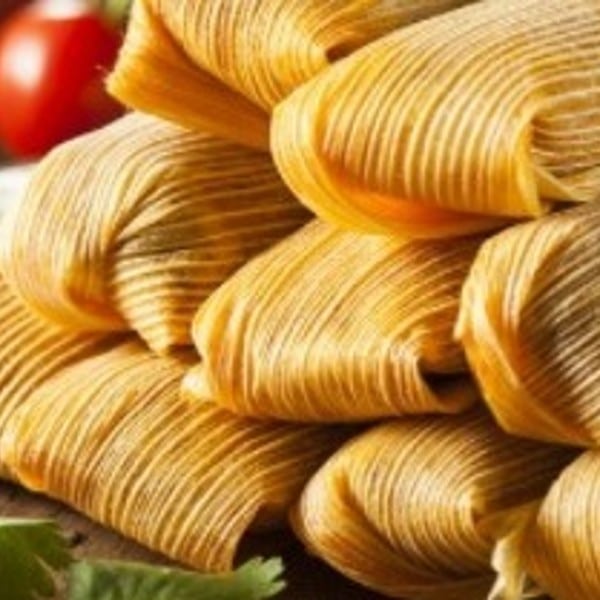
Cooking Tips
The most common mistake beginners make is not grinding the fried rice finely enough. If you leave coarse bits in the powder, the paste will be gritty rather than smooth. Grind in short bursts and check with your fingers. Also watch the thickening stage carefully — the rice paste goes from liquid to thick fairly quickly over low heat, and if you step away, it can catch on the bottom of the pan.
Keep stirring and pull it off the heat the moment it starts to hold its shape. For the orange food colour, use just enough to coat the chicken; too much and it pools into the rice when you assemble.
Top Tips
- Roast the peanuts dry in a pan before you start anything else so they have time to cool — warm peanuts will steam inside the parcel and lose their crunch.
- Soften the banana leaves over direct steam or an open flame for about 30 seconds per side so they fold without cracking along the edges.
- I always double-wrap each parcel because a single leaf layer sometimes splits during the long boiling time, and you do not want the filling soaking in water.
- Use kitchen twine or even torn strips of banana leaf to tie the packets — just make sure the knot is firm, because loose parcels will unfold in the boiling water.
- The rice paste thickens further as it cools, so pull it off the heat when it still looks slightly loose — it will firm up to the right consistency by the time you assemble.
- Cooked and cooled chicken slices work better than freshly hot ones because they hold their shape when you fold the leaf over them.
Serving and Storing Suggestions
Serving size: Makes around 8 to 10 parcels, enough for 3 to 4 people as a main. Total prep and cook time is around 90 minutes. Serve the tamales warm, unwrapped at the table so people can open their own parcels — the aroma that comes out when the leaf is pulled back is part of the experience. Leftovers keep well in the refrigerator for up to two days. To reheat, drop the sealed parcels back into simmering water for about 10 minutes rather than microwaving, which tends to dry the rice paste out.
Similar Recipes
- Pork Tamales
- Filipino Suman (Sticky Rice in Banana Leaf)
- Puttu with Chicken Curry
- Banana Leaf Rice with Coconut Chicken
- Thai Sticky Rice Parcels with Chicken
Nutrient Benefits
Chicken breast is a lean protein source that keeps each parcel reasonably light despite the richness of the coconut milk. Peanuts contribute healthy fats and a small amount of fibre per serving. Coconut milk adds medium-chain fatty acids, which the body processes differently from most other fats. Because the tamales are boiled rather than fried, the overall fat content stays moderate. The egg inside each parcel rounds out the protein count, making these parcels more filling than their size suggests.

Chicken Tamales
Ingredients
- 1 cup Basmati Rice
- 1 cup Water
- 200 ml Coconut Milk
- 1 Chicken Breast (small, skinless, boneless, cooked, sliced)
- 3 to 4 tbsp Peanuts (roasted)
- 1 Egg (hard-boiled, sliced)
- 5 cups Water
- 1/2 tsp Salt
- Black Pepper Powder (a pinch)
- 1/2 tsp Brown Sugar
- Banana Leaves (few, cut into squares, soften over steam)
- 1/2 tsp Edible Orange Food Colour (mixed with 1/4 cup water)
Instructions
- Heat a pan over medium flame.
- Add the rice and fry until lightly browned.
- Remove and grind to a fine powder.
- Transfer to a pan and pour 1 cup of water, coconut milk, sugar, salt and pepper powder.
- Simmer over low flame until it starts to thicken.
- In a separate pan mix the chicken pieces and food colour water.
- Cook until the chicken pieces turn orange.
- Drain and keep aside.
- Place the banana leaf on a clean surface.
- Spoon about 1 tblsp of the rice mixture, a chicken piece, 1/2 to 1 tsp of peanuts and an egg slice on top.
- Fold the banana leaf over the mixture to form a square packet.
- Place this inside another banana leaf and fold the same way.
- Secure with a twine and repeat until all ingredients are used up.
- Pour 5 cups of water into a pot and bring to a boil.
- Drop the packets into the boiling water and cook over high flame for 20 to 30 minutes.
- Remove and drain excess water.
- Cool to room temperature and serve.
Sign up for our newsletter
Add Awesome Cuisine as a Preferred Source

Frequently Asked Questions
My rice paste turned out lumpy instead of smooth. What went wrong?
The most likely cause is that the rice was not ground finely enough before you added the liquid. Fry the rice until it is a pale golden colour, let it cool slightly, then grind in a dry blender for at least two full minutes, stopping to check the texture with your fingers. It should feel like a fine powder with no coarse grit before you add the coconut milk and water.
Can I use regular white rice instead of Basmati for this recipe?
Yes, regular raw white rice works fine here. Basmati gives a slightly more fragrant paste because of its natural aroma, but any short or medium-grain raw rice will produce a similar smooth texture once ground and cooked. Avoid using pre-cooked or parboiled rice because it will not grind to a proper powder.
The banana leaf kept cracking when I tried to fold it. How do I prevent that?
The leaves need to be softened before you fold them. Hold each square about five centimetres above a gas flame or over a pot of boiling water for 20 to 30 seconds. You will see the colour deepen slightly and the leaf will become pliable. Do this just before you assemble — leaves that have been softened and then left to sit for too long will dry out and crack again.
Some of my parcels came open during boiling and the filling leaked into the water. How do I stop this from happening?
Two things usually cause this. Either the twine was not tied tightly enough, or only one leaf layer was used. Always double-wrap each parcel — place the folded packet seam-side down onto a second banana leaf square and fold that one the same way. Then tie firmly with twine, tucking the knot in so it does not loosen in the water.
Can I prepare these the night before and boil them the next day?
Yes, assembling the parcels ahead of time works well. Once wrapped and tied, arrange them on a tray, cover with a damp cloth or cling film, and refrigerate overnight. Boil them straight from the refrigerator the next day, but add an extra five minutes to the cooking time to account for the cold start.