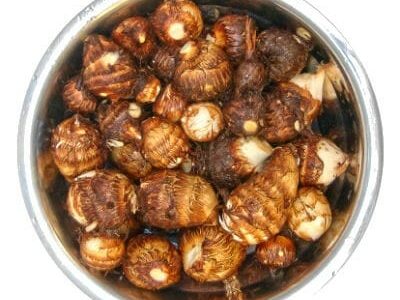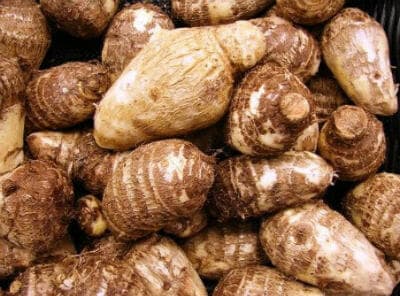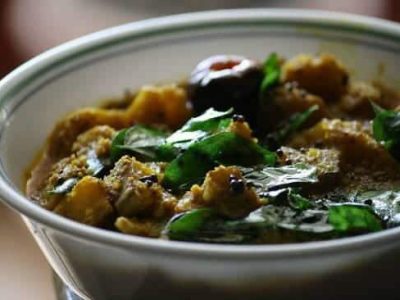
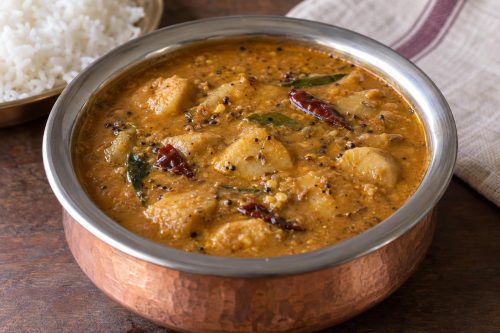
Cheppankizhangu Paruppu Kuzhambu brings together colocasia and toor dal in a tamarind-based gravy. Colocasia, called cheppankizhangu in Tamil and taro root in English, is a starchy root vegetable that holds its shape well once boiled and sliced. Combined with cooked toor dal and a freshly ground paste of dry coconut, sesame seeds, coriander and pepper, this kuzhambu has a full-bodied texture and a pleasantly earthy flavour. It pairs naturally with plain steamed rice and comes together without any complicated technique.
About the Recipe
The recipe works in three stages that come together at the end. The toor dal is pressure cooked, the colocasia is boiled separately and peeled after cooling, and the spice paste is dry-roasted in ghee before grinding.
Tamarind juice is simmered for at least ten minutes to remove its raw edge before anything else is added. If the kuzhambu is thinner than you would like after adding the dal and colocasia, rice flour dissolved in water brings it to the right consistency. A final ghee tempering with mustard seeds, fenugreek and curry leaves goes in just before serving.
Why You Will Love This Recipe
The freshly ground spice paste sets this kuzhambu apart from a standard sambar. Roasting dry coconut, sesame seeds, coriander seeds and black pepper in ghee before grinding gives the paste a toasted, nutty quality that a ready-made powder cannot match.
The colocasia absorbs the tamarind and spice base as it simmers, so each piece carries flavour all the way through. The ground coconut and sesame also add body to the gravy, so the finished dish feels satisfying with just a bowl of plain rice.
Cooking Tips
The most common mistake is cutting the tamarind simmer short. If you do not give it the full ten minutes, the raw sharpness stays in the finished dish.
Peel the colocasia only after it has cooled completely. The skin slips off cleanly and handling is much easier. When grinding the spice paste, add water gradually so the paste stays smooth rather than watery. Keep the heat low when roasting the spice paste ingredients so the coconut and sesame do not burn.
Top Tips
- Boil the colocasia until fully tender before slicing. Undercooked colocasia stays hard even after simmering in the kuzhambu.
- Cool the colocasia completely before peeling. The skin comes away much more easily once it is no longer hot.
- Simmer the tamarind juice for the full ten minutes over low heat. This removes the raw sourness and cannot be rushed.
- Roast the spice paste ingredients over low heat and keep them moving in the pan so the coconut and sesame colour evenly without burning.
- Add the rice flour slurry only if the kuzhambu is genuinely too thin. Stir frequently during the final five minutes so it does not settle and catch at the bottom.
- Add the tempering ingredients in the order listed. Give the fenugreek seeds a few seconds before the curry leaves go in.
Serving and Storing Suggestions
Serve Cheppankizhangu Paruppu Kuzhambu hot with plain steamed rice. A little ghee stirred into the rice before ladling the kuzhambu over it works well.
Leftover kuzhambu keeps in the refrigerator for up to two days in a sealed container. Reheat gently over low heat with a splash of water, as the dal thickens further once cold. The tamarind and spice paste flavours tend to deepen on the second day.
Similar Recipes
- Kovakkai Puli Kuzhambu (Ivy Gourd Sambar)
- Pirandai Kuzhambu
- Chinna Kathirikai Kuzhambu (Small Brinjal Sambar)
- Ennai Kathirikkai Kuzhambu
- Pepper Kuzhambu
Nutrient Benefits
Toor dal is a good source of plant protein and provides iron and B vitamins. Colocasia contributes dietary fibre and potassium. Sesame seeds add calcium and healthy fats. The ghee used in the spice paste and tempering is used in small quantities across the whole dish.
Cheppankizhangu Paruppu Kuzhambu
Ingredients
- 3/4 cup Toor Dal (Tuvaram Paruppu)
- 1 1/2 cups (250gms) colocasia (Cheppankizhangu)
- 1 medium lemon sized ball of tamarind
- 1/2 tsp turmeric powder
- 1 tsp salt or to taste
- 1 tsp rice flour (if required)
- Spice paste
- 2 tsp ghee
- 4-5 dried red chillies
- 3 tsp coriander seeds
- 1/2 tsp black peppercorns
- 1 tbsp grated dry coconut
- 1 tsp white sesame seeds
- Tempering
- 2 tsp ghee
- 1 tsp mustard seeds
- 1/2 tsp fenugreek seeds
- 1/2 tsp cumin seeds
- 1/2 tsp asafoetida powder
- 1 dried red chilli, halved
- 1 sprig curry leaves
Instructions
- Wash dal and drain. Place dal in a pressure cooker with 1 cup water and cook under pressure for 5 minutes.
- Boil colocasia in enough water to cover till tender. Drain, cool and peel. Slice colocasia into 1/2 inch pieces.
- Soak tamarind in 1 cup water for 10 minutes. Extract juice and discard pulp.
- Heat ghee for spice paste in a wok/frying pan and add remaining ingredients for spice paste. Fry over low heat, tossing gently, till fragrant. Grind to a smooth consistency, gradually adding 2-3 tbsp water.
- To the same frying pan, add tamarind juice, turmeric powder and salt. Place pan over high heat and bring to boil. Lower heat and simmer for atleast 10 minutes till the raw aroma of tamarind disappears.
- Mix in dal, colocasia and spice paste. Simmer for about 5 minutes, stirring occasionally.
- If kuzhambu is not thick enough, dissolve rice flour in 1/2 cup water and add to pan. Simmer for another 5 minutes, stirring frequently.
- Heat ghee for tempering in a small pan over moderate heat. Add remaining ingredients for tempering in the order given. When mustard seeds splutter, stir contents of pan into kuzhambu.
- Serve hot with plain rice.
Sign up for our newsletter
Add Awesome Cuisine as a Preferred Source

Frequently Asked Questions
What is cheppankizhangu in English, and can I find it easily?
Cheppankizhangu in English is taro root, also called colocasia. It is widely available in Indian grocery stores and many general supermarkets, usually sold loose or in small bags in the vegetable section. Choose firm pieces without soft spots or blemishes. The size does not matter much for this recipe since you slice them after boiling.
Why does the recipe ask me to boil the colocasia separately instead of cooking it directly in the kuzhambu?
Boiling colocasia separately gives you control over how cooked it is before it goes into the tamarind gravy. If you add raw colocasia directly to the kuzhambu, it can turn mushy or take too long to cook through, and the tamarind base may over-reduce in the meantime. Boiling it first, then slicing and adding it at the final simmer stage, keeps the pieces intact and lets them absorb the flavours without falling apart.
Can I use ready-made sambar powder instead of grinding the spice paste from scratch?
The fresh spice paste, made from dry coconut, sesame seeds, coriander seeds and black pepper roasted in ghee, gives the kuzhambu a texture and flavour that sambar powder cannot fully replicate. Sambar powder is a reasonable shortcut if you are short on time, but the kuzhambu will taste noticeably different and will be thinner in body since the ground coconut and sesame also add thickness to the gravy.
My kuzhambu turned out very thin. What went wrong and how do I fix it?
A thin kuzhambu usually happens when the tamarind juice is not simmered long enough, or when the spice paste was ground with too much water. The recipe includes rice flour dissolved in half a cup of water as a fix. Add it gradually while stirring, then simmer for another five minutes. Stir frequently during this stage so the flour does not settle and stick to the bottom of the pan.
Is it possible to make this dish without a pressure cooker?
Yes. You can cook the toor dal in an open pot with enough water to cover it by a couple of inches. It will take around 30 to 40 minutes over medium heat until the dal is completely soft and mashable. Skim off any foam that rises during cooking. The dal does not need to be perfectly smooth for this recipe since it simmers further in the kuzhambu, but it should be fully cooked before you add it.