
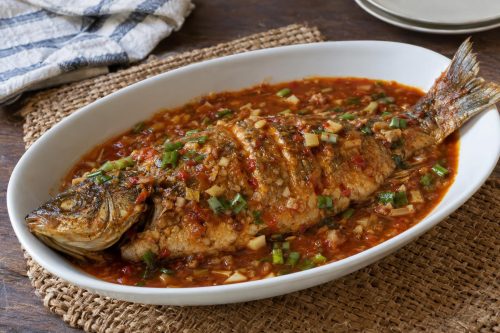
This Braised Whole Fish in Chilli and Garlic Sauce is a straightforward Chinese-style preparation that produces a genuinely satisfying result without requiring specialist equipment or hard-to-find ingredients. The fish is first fried in the wok to give the skin some colour and firmness, then the sauce is built in the same wok so nothing is wasted. Chilli bean sauce, garlic, ginger, tomato puree and a splash of rice vinegar come together quickly, and the fish finishes cooking right in the sauce. If you enjoy dishes like Fish in Spicy Sauce, this recipe covers similar ground but with a distinctly Chinese flavour profile.
About the Recipe
The technique here is two-stage: fry first, then braise. Scoring the fish down to the bone on both sides is not decorative. It allows the soy sauce and rice wine marinade to penetrate quickly and helps the fish cook evenly during braising. The sauce uses chilli bean sauce as its base, which already carries heat and saltiness, so taste before adding extra seasoning. Cornflour paste is stirred in at the end to bring the sauce to a coating consistency rather than a watery one. A few drops of sesame oil go on just before serving.
Why You Will Love This Recipe
The main reason to make this recipe is the contrast between the fried exterior and the braised finish. Because the fish is fried before the sauce goes in, the skin holds its shape and picks up colour that a purely steamed or poached fish would not have. Then the four to five minutes of braising softens the flesh through without drying it out, and the sauce clings to the scored cuts rather than running off. You get a dish that looks and tastes like it took considerably more effort than it actually did. The whole process from wok to table takes well under thirty minutes.
Cooking Tips
The most common beginner mistake is adding the fish to oil that is not hot enough, which causes it to stick and tear. The oil must be properly hot before the fish goes in. Pat the fish completely dry after marinating or the oil will spit badly. When braising, turn the fish only once and do so gently using two spatulas. Do not overcrowd the wok with sauce ingredients before the fish has had its four to five minutes, or the liquid will steam rather than braise.
Top Tips
- Dry the fish thoroughly with kitchen paper after marinating. Any surface moisture will cause the oil to spit and the skin to stick.
- Score the fish deep enough to reach the bone. Shallow cuts do not allow the marinade or the braising sauce to penetrate the flesh.
- Keep the white and green parts of the spring onions separate. The white parts go in with the sauce base and the green parts are added at the end for freshness.
- Stir the cornflour paste just before adding it as the cornflour settles quickly. Add it gradually and stir as you go to avoid lumps.
- Taste the sauce before the cornflour goes in. Chilli bean sauce varies in saltiness between brands, so adjust with a little more vinegar or sugar if needed.
- Serve immediately once the sesame oil is added. The sauce thickens further as it sits and the fish texture is best straight from the wok.
Serving and Storing Suggestions
Serve the fish whole at the table with steamed white rice, which absorbs the sauce well. A simple stir-fried green vegetable alongside keeps the meal balanced. This dish does not store well because the fried skin softens quickly once the fish sits in the sauce. If you do have leftovers, refrigerate them in a covered container and eat within one day. Reheat gently in a covered pan with a splash of water rather than microwaving, which tends to toughen the fish.
Similar Recipes
- Fish in Spicy Sauce
- Vegetable Balls in Hot Garlic Sauce
- Fish in Methi and Garlic
- Stuffed Fish with Almond Sauce
Nutrient Benefits
Whole fish such as sea bass, bream and trout are good sources of protein and provide B vitamins including B12. Garlic and ginger contribute small amounts of minerals. Using a moderate quantity of oil and draining the fish well before braising keeps the overall fat content reasonable for a deep-fried preparation. The portion size of approximately 675 grams serves two to three people, so individual servings are not excessively large.
Braised Whole Fish in Chilli and Garlic Sauce
Ingredients
- 1 , about 675 gms Carp, Bream, Sea Bass, Trout, Grouper or Grey Mullter
- 1 tblsp Light Soy Sauce
- 1 tblsp Rice Wine or Dry Sherry
- Vegetable Oil - for deep frying
- For the sauce:
- 2 cloves, finely chopped Garlic
- 2 to 3, finely chopped, the white and green parts separated Spring Onions
- 1 tsp, finely chopped Fresh Root Ginger
- 2 tblsp Chilli Bean Sauce
- 1 tblsp Tomato Puree
- 2 tsp Light Brown Sugar
- 1 tblsp Rice Vinegar
- 1/2 cup Chicken Stock
- 1 tblsp, mixed to a paste with 2 tsp water Cornflour
- Sesame Oil - a few drops
Instructions
- Rinse and dry the fish well. Using a sharp knife, score both sides of the fish down to the bone with diagonal cuts about 1 inch apart.
- Rub both sides of the fish with the soy sauce and rice wine or sherry. Set aside for 10-15 minutes to marinate.
- Heat sufficient oil for deep frying in a wok. When it is hot, carefully add the fish and fry for 3 to 4 minutes on both sides until golden brown.
- To make the sauce, pour away all but about 1 tblsp of the oil.
- Push the fish to one side of the wok and add the garlic, the white part of the spring onions, the ginger, chilli bean sauce, tomato puree, sugar, vinegar and chicken stock.
- Bring to the boil and braise the fish in the sauce for 4-5 minutes, turning it over once.
- Add the green of the spring onions.
- Stir in the cornflour paste to thicken the sauce.
- Sprinkle over a little sesame oil and serve immediately.
Sign up for our newsletter
Add Awesome Cuisine as a Preferred Source

Frequently Asked Questions
Which fish works best for this braised whole fish recipe?
The recipe lists carp, bream, sea bass, trout, grouper and grey mullet as suitable choices. The key requirement is a firm-fleshed fish that can withstand deep frying and a short braise without falling apart. Sea bass and bream are widely available and hold their shape well. Avoid very thin or delicate fish that will break when you try to turn them in the wok.
Can I use dry sherry instead of rice wine?
Yes. The recipe specifically offers dry sherry as an alternative to rice wine. Both are used in a small quantity, just one tablespoon, and their role is to add a mild depth to the marinade rather than a strong alcohol flavour. Avoid sweet sherry as it will change the balance of the sauce.
How do I know when the oil is hot enough to fry the fish?
Lower a wooden chopstick or the handle of a wooden spoon into the oil. If small bubbles rise steadily around it, the oil is ready. You can also drop a tiny piece of spring onion into the oil; if it sizzles immediately, the temperature is sufficient. Adding the fish to cool oil is the most common reason the skin sticks and tears.
What can I use if I cannot find chilli bean sauce?
Chilli bean sauce is the base of the sauce and gives it its characteristic flavour, so a direct substitute is not straightforward. If it is unavailable, a combination of a mild chilli paste and a small amount of fermented black bean paste can approximate the result, though the flavour will differ. Some shops stock it as doubanjiang or toban djan. It is worth seeking out for this recipe.
Why does the recipe ask me to braise the fish in the same wok used for frying?
Building the sauce in the same wok means the flavour left from frying the fish becomes part of the sauce base. It also means one less pan to wash. The instruction to pour away all but about one tablespoon of oil before adding the sauce ingredients is important. Too much residual oil will make the sauce greasy rather than glossy.