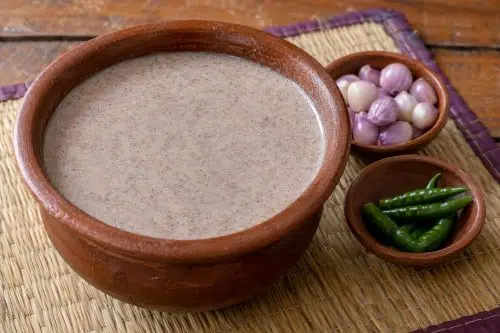
Kezhvaragu Koozh is a traditional Tamil porridge made from ragi flour, known in Tamil as கேழ்வரகு. It is cooked to a thick consistency, rested for several hours, and then loosened with curd before serving. The result is a cool, tangy, lightly sour porridge that pairs naturally with raw shallots and green chillies.
If you have been wondering what koozh is or how to make it at home, this recipe covers the full process with only five ingredients. Nothing about it is complicated, but the resting time is not optional, so start the night before if you plan to serve it the next morning.
இந்தச் செய்முறை குறித்து
The recipe uses ragi flour cooked in water until it thickens, then covered and left undisturbed for eight hours or overnight. During this time the koozh sets into a firm, dense mass.
Whisked curd is then added and mixed in thoroughly until the texture is smooth and pourable. Two cups of flour to five cups of water gives a porridge that is thick enough to hold its shape but loose enough to mix cleanly with the curd.
Serving it with peeled shallots and whole green chillies is traditional and cuts through the mild sourness of the curd well.
நீங்கள் ஏன் இந்த சமையல் குறிப்பை விரும்புவீர்கள்
The strongest reason to make this recipe is how little active effort it needs. You cook the ragi mixture for a few minutes, leave it overnight, then stir in curd the next morning. There is no tempering, no grinding, and no special equipment involved.
Ragi flour also performs reliably here. It thickens steadily and holds its texture through the long rest without going watery or grainy. If you already use ragi for dishes like Ragi Dosa or Ragi Roti, this is a useful addition to your repertoire that uses the same flour in a completely different way.
சமையல் குறிப்புகள்
The most common beginner mistake is adding the flour to hot water, which causes lumps immediately. Always mix the ragi flour into cold or room-temperature water first and stir until fully smooth before placing the pan on the flame.
Once it starts to thicken, stir continuously to prevent the bottom from catching. Do not skip the resting period. A koozh that has not rested long enough will taste raw and floury.
When adding curd, whisk it separately first so it blends in without leaving streaks or uneven patches.
முக்கியக் குறிப்புகள்
- Mix the ragi flour into cold water before turning on the heat. Adding flour directly to hot water creates lumps that are very difficult to remove later.
- Stir the mixture continuously once it goes on the flame, especially as it begins to thicken, to prevent scorching at the bottom of the pan.
- The eight-hour rest is what gives Kezhvaragu Koozh its texture and mild flavour. Do not shorten this step.
- Whisk the curd until completely smooth before adding it to the koozh. Lumpy or very cold curd straight from the fridge does not mix in evenly.
- Adjust the amount of curd to your preference. More curd makes the koozh thinner and tangier; less keeps it thicker and milder.
- Serve with the shallots and green chillies on the side so each person can take as much or as little as they like.
பரிமாறுதல் மற்றும் சேமித்து வைத்தல் குறித்த ஆலோசனைகள்
Kezhvaragu Koozh is best served cold or at room temperature in small cups or tumblers. The shallots and green chillies are placed on the side and eaten alongside.
Leftovers can be refrigerated for up to a day. The koozh thickens further in the fridge, so stir in a small amount of curd or water before serving again. Do not freeze it, as the texture breaks down on thawing.
இதே போன்ற சமையல் குறிப்புகள்
- Ragi Dosa (Ragi Dosai)
- Ragi Adai
- Ragi Kozhukattai
- Ragi Rava Dosa
- Cucumber Curd Pachadi (Vellarikai Thayir Pachadi)
ஊட்டச்சத்து நன்மைகள்
Ragi flour is a good source of calcium and iron compared to most common grains. It also contains dietary fibre and protein, which makes this koozh reasonably filling for its size. Curd adds protein and some B vitamins, and shallots contribute small amounts of vitamin C. For more on what ragi flour offers nutritionally, see this overview of ragi benefits.
Kezhvaragu Koozh
தேவையான பொருட்கள்
- 2 cups Kezhvaragu (Ragi) Flour
- 4 cups Curd
- Salt as required
- 3 to 5, to serve Green Chillies
- 100 gms, peeled, to serve Small Onions (Shallots)
செய்முறை
- Transfer the ragi flour into a large, heavy-bottomed pan.
- Pour 5 cups of water and little salt.
- Mix well until no lumps remain.
- Place it over medium flame and bring to a boil.
- Remove when it has thickened slightly.
- Cover and keep aside for 8 hours or overnight.
- Whisk the curd and add to the koozh.
- Mix well without any lumps.
- Pour into small cups.
- Serve with peeled onions and green chillies.
அடிக்கடி கேட்கப்படும் கேள்விகள்
What is Kezhvaragu Koozh and what does it taste like?
Kezhvaragu Koozh is a traditional Tamil porridge made from ragi flour, also known as finger millet flour. It is cooked with water, rested overnight, and then mixed with curd. The flavour is mild and slightly earthy from the ragi, with a gentle sourness from the curd. The texture is smooth and thick, somewhere between a porridge and a drink. It is usually served cool, not hot.
Why does the koozh need to rest for eight hours?
The resting period allows the cooked ragi to set properly and develop the mild flavour that makes koozh what it is. A koozh that has not rested will taste floury and raw. The long rest also makes it easier to mix with curd later, as the texture becomes firm and even.
Can I use store-bought ragi flour for this recipe?
Yes, store-bought ragi flour works well here. Make sure it is fine-ground flour and not ragi rava or broken ragi, as those will not give a smooth texture. Check that the flour is fresh and has no musty smell before using it.
My koozh has lumps after mixing with curd. What went wrong?
Lumps usually form for one of two reasons. Either the flour was not mixed smoothly into the water before cooking, or the curd was not whisked before being added to the set koozh. To fix lumps in the finished koozh, whisk the mixture vigorously or press it through a fine sieve. Going forward, always mix flour into cold water first and whisk the curd separately before combining.
Can I use regular yogurt instead of curd?
Plain, unsweetened yogurt can be used in place of homemade curd and will give a similar result. Avoid flavoured or sweetened yogurt as those will change the taste significantly. Greek yogurt is too thick and will need to be thinned with a little water before adding to the koozh.