
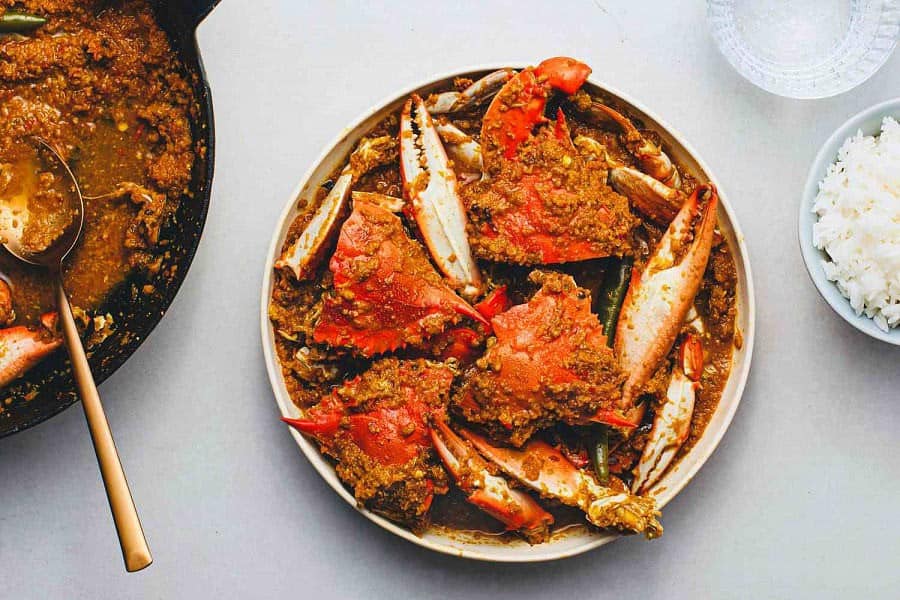
Crab Curry with Coconut was the dish that made me realise I had been rushing seafood my entire cooking life. I first had a version of this at a small coastal restaurant in Kerala years ago, the kind of place with plastic chairs and fish drying on a line outside. The gravy was dark, slightly thick, and smelled of roasted coconut in a way I could not stop thinking about.
I pestered the owner until she gave me a rough outline of the method. It took several tries at home before I got the coconut paste right. The trick, I eventually figured out, is frying the coconut until it is genuinely brown, not just golden. That extra minute or two in the pan gives the whole curry a nuttier, rounder base that no amount of extra spice can replicate.
About the Recipe
Most of the ingredients here are pantry staples in an Indian household. Small onions, curry leaves, dried red chillies, coriander powder, and a piece of fresh ginger are things most of us already have. Fresh or frozen crab meat works well, so sourcing is rarely a problem. The full cook, including making the coconut paste and the tempering, comes together in about 45 to 50 minutes. I make this on Sundays when I want something that feels considered without spending the whole afternoon in the kitchen.
Why you will love this recipe
The roasted coconut paste is what keeps me coming back to this particular recipe. Most coconut-based curries use raw or lightly fried coconut, which gives a mild, creamy quality. Here, you brown the coconut properly before grinding it, and that changes the character of the gravy entirely. It becomes richer, slightly smoky, and much more interesting alongside plain steamed rice.
The tempering at the end, just a small amount of oil with onions and curry leaves hissing in the pan until the onions turn brown, is a small step that adds a noticeable crunch and fragrance on top of the finished curry. Together, the two pastes and the tempering give this dish more layers than you would expect from a recipe this size.
Cooking Tips
The most common mistake is under-frying the coconut. If it is pale when you grind it, the paste will taste flat. Let it go until genuinely brown on medium heat, which takes about 5 to 7 minutes. Stir it often because coconut scorches quickly once it starts to colour.
The second thing beginners miss is heat control when cooking the crab. Keep it on low to medium heat for the first 10 minutes or the crab meat toughens before the flavours have time to come together.
Top Tips
- Do not skip browning the coconut – pale coconut paste makes a noticeably blander gravy. Give it a full 5 to 7 minutes on medium heat, stirring often.
- Grind the coconut paste with exactly 1/3 cup of water. Too much water thins the gravy and it takes much longer to reduce.
- If your crab meat is frozen, thaw and pat it dry before adding it to the pan. Excess water dilutes the spice paste and makes the salt hard to judge.
- Taste the gravy before adding the coconut paste. This is your last easy chance to adjust salt or heat.
- For the tempering, use a small pan and make sure the oil is properly hot before adding the onions. You want a sharp sizzle, not a slow steam.
Serving and Storing Suggestions
Serves 2. Preparation and cooking time is about 45 to 50 minutes total. Serve hot with plain steamed rice. The gravy thickens as it cools, so add a splash of warm water when reheating on the stove.
Store leftovers in a sealed container in the refrigerator for up to 2 days. I find the flavour actually deepens overnight, so next-day portions are worth saving. Do not freeze this curry as the crab meat becomes rubbery after thawing.
Similar Recipes
- Kerala Prawn Curry with Coconut Milk
- Fish Moilee
- Chettinad Crab Masala
- Goan Prawn Curry
- Coconut Mussel Curry

Crab Curry with Coconut
Ingredients
- 250 gms Crab meat (cleaned, washed, chopped into small pieces)
- 1/2 tsp Salt
- 1 to 2 Small Onions (chopped)
- 2 Green Chillies (chopped)
- Ginger - 1 inch piece, chopped
- Curry Leaves (few)
For coconut paste:
- 1/2 tbsp Oil - 1/2 tblsp
- 1/4 cup Coconut - 1/4 cup grated
- 2 Small Onions - 2 chopped
- 1/2 tsp Black Pepper Powder - 1/2 tsp
- 1 clove Garlic - 1 clove chopped
Grind to a fine paste:
- 4 to 5 Dry Red Chillies (broken)
- 3/4 tbsp Coriander Powder
- 1/2 tsp Turmeric Powder
- 2 tsp Water
For tempering:
- 1/4 tbsp Oil
- 1 to 2 Small Onions (chopped)
- Curry Leaves (few)
Instructions
- To make the coconut paste, heat oil in a pan.
- Fry the coconuts and onions till coconut turns brown.
- Add pepper and garlic.
- Fry for 45 seconds to a minute.
- Remove, cool and grind to a fine paste with 1/3 cup of water.
- Heat a pan over low heat.
- Add crab meat with salt and 3/4 cups of water.
- Cook for 10 minutes.
- Add the small onions, green chillies, ginger and curry leaves.
- Bring to a boil.
- Add the ground paste and bring to boil.
- Add the coconut paste and cook till gravy thickens.
- Remove from heat and keep aside.
- Heat oil for tempering.
- Fry small onions and curry leaves till onions turn brown.
- Pour this into the crab curry and mix well.
- Serve hot with rice.
Sign up for our newsletter
Add Awesome Cuisine as a Preferred Source

Frequently Asked Questions
My gravy turned out very thin. What went wrong?
This usually happens when too much water is added while grinding the coconut paste, or if the heat is too high when cooking and the liquid does not reduce. Keep the heat at medium after adding the coconut paste and let it simmer uncovered for a few extra minutes, stirring occasionally, until it reaches a thicker consistency.
Can I use canned crab meat instead of fresh?
Yes, canned crab meat works, but drain it well and reduce the salt in the recipe slightly because canned varieties are usually pre-salted. The texture will be slightly softer than fresh crab, but the flavour holds up well in the gravy.
The coconut paste smells bitter. Did I burn it?
If the coconut turned dark brown and smells acrid rather than nutty, it has gone too far. Unfortunately there is no fixing a burnt paste. Start the coconut paste again with fresh coconut on a lower flame. Aim for a warm, toasty brown, not a dark brown with any black patches.
I cannot find small onions. Can I use regular onions?
You can use regular onions, but reduce the quantity by about half because they have a stronger, sharper flavour. Small onions, also called shallots or pearl onions, are milder and sweeter, which is part of what gives this curry its balance. If you are near an Indian grocery, they are usually easy to find.
Can I make the coconut paste ahead of time?
Yes. Grind the coconut paste and store it in a sealed container in the refrigerator for up to one day before cooking. Give it a quick stir before adding it to the curry. Making it ahead can save you around 15 minutes on the day you cook.
Note: image is for illustration purposes only and not that of the actual recipe.