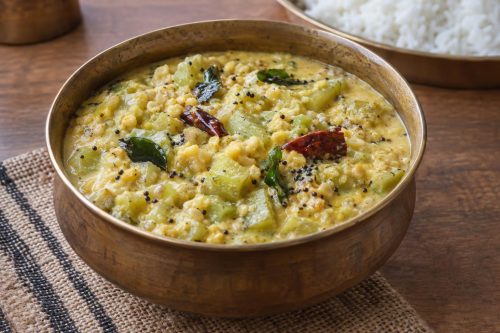
Thengaipal Poritha Kootu is a Tamil-style vegetable and dal preparation where the vegetables are cooked with sambar powder and turmeric, then brought together with a coarsely ground roasted masala and cooked moong dal. The name tells you the defining step: thengaipal means coconut milk, and it is stirred in right at the finish. The result sits somewhere between a dry curry and a thick gravy, making it a natural companion to plain steamed rice. Both snake gourd and ridge gourd soften quickly, so the whole dish comes together without much fuss.
About the Recipe
The recipe builds flavour in stages. The moong dal is dry-roasted before pressure cooking, which keeps it from turning mushy. The masala is made by frying peppercorns, urad dal, asafoetida and rice in ghee until the dal turns golden, then grinding them coarse with cumin seeds added off the heat. This coarse paste thickens the kootu and adds a mild, nutty quality throughout.
Fresh coconut milk is extracted by blending grated coconut with hot water. It goes in only after the pan is removed from the heat, keeping it from splitting or tasting cooked.
Why You Will Love This Recipe
The dal is soft but not dissolved, the vegetables hold their shape, and the coarse masala gives small bursts of flavour in every spoonful. Because the coconut milk goes in off the heat, it stays fresh and rounds the dish out without making it heavy.
The ingredient list is straightforward and most items are pantry staples in a South Indian kitchen. It is light enough for everyday cooking but has enough character to stand on its own alongside rice.
Cooking Tips
The most common mistake here is adding the coconut milk while the pan is still on the heat. This causes the milk to curdle or take on a slightly grainy quality. Always remove the pan from the flame first.
The masala should stay coarse, not smooth. A smooth paste changes the texture of the finished kootu noticeably, so use only 2 tablespoons of water while grinding and stop early.
Do not skip dry-roasting the moong dal before pressure cooking. Without that step the dal tends to go sticky and clump together in the pot.
Top Tips
- Remove the pan from heat completely before adding coconut milk to prevent it from splitting.
- Grind the masala to a coarse paste, not a smooth one. Use only 2 tablespoons of water while grinding.
- Add cumin seeds only after removing the pan from heat before grinding, as frying them in ghee can make them bitter.
- Cut the vegetables into even half-inch cubes so they cook at the same rate and do not turn mushy.
- Dry-roast the moong dal for a full two minutes before washing it. The dal should smell nutty and look slightly deeper in colour.
- Extract coconut milk with hot water, not cold, to get a fuller yield from the grated coconut.
Serving and Storing Suggestions
Serve Thengaipal Poritha Kootu hot with plain steamed rice. It also works well alongside Drumstick Sambar or Palakkad Sambar as part of a larger meal.
Leftovers can be refrigerated for up to a day. Reheat gently on a low flame and add a small splash of water if the kootu has thickened too much. Do not let it boil after reheating as the coconut milk can separate.
Similar Recipes
Nutrient Benefits
Moong dal is a good source of plant protein and provides iron and B vitamins. Snake gourd and ridge gourd contribute dietary fibre and vitamin C. Fresh coconut adds some fat and energy to the dish. Together, this kootu makes for a reasonably balanced vegetarian side when eaten with rice.
Thengaipal Poritha Kootu
Ingredients
- 1/2 cup Moong Dal
- 1 1/4 cups, grated Fresh Coconut
- 2 cups, cut into 1/2 inch cubes Snakegourd
- 2 cups, cut into 1/2 inch cubes Ridgegourd
- 1/2 tsp Turmeric Powder
- 1 tsp Sambar Powder
- Salt as per taste
- For Masala:
- 2 tsp Ghee
- 1 tsp Black Peppercorns
- 1 tblsp Urad Dal
- 1/2 tsp Asafoetida Powder
- 2 tsp Rice
- 1 tsp Cumin Seeds
- For Tempering:
- 2 tsp Ghee
- 1 tsp Mustard Seeds
- 1 , halved Dry Red Chilli
- Curry Leaves - few
Instructions
- Roast the moong dal in a frying pan for 2 minutes.
- Wash well and drain.
- Pressure cook with 1 cup of water for 5 minutes.
- Mix coconut with 1/2 cup of hot water.
- Grind for 1 to 2 minutes and extract coconut milk.
- Heat ghee for the masala in the same pan.
- Add all the masala ingredients, except cumin seeds.
- Fry till dal turns golden.
- Remove from heat.
- Add cumin seeds and grind to a coarse paste with 2 tblsp of water.
- Add the vegetables, turmeric, sambar podi, salt and 3/4 cup of water in the same pan.
- Cover pan and simmer till vegetables are tender, over moderate heat.
- Add the masala and simmer for another 60 seconds.
- Add the cooked dal and simmer for 5 more minutes.
- Stir from time to time till well blended.
- Heat ghee for tempering and fry the remaining tempering ingredients.
- When mustard seeds start spluttering, add it to the kootu.
- Remove from heat.
- Add coconut milk and stir.
- Serve hot with plain rice.
Sign up for our newsletter
Add Awesome Cuisine as a Preferred Source

Frequently Asked Questions
Can I use canned coconut milk instead of extracting fresh coconut milk?
You can, but the flavour will be noticeably different. Canned coconut milk is richer and has a more processed taste. Fresh coconut milk made by blending grated coconut with hot water gives a lighter, cleaner result that suits this kootu better. If you do use canned milk, reduce the quantity slightly and still add it off the heat.
Can I use a single vegetable instead of both snake gourd and ridge gourd?
Yes. Either vegetable works on its own. Keep the total quantity at around 4 cups so the ratio of vegetables to dal and masala stays balanced. Ash gourd is another option that works well in this kootu.
Why does the recipe ask for rice in the masala? Can I leave it out?
The small amount of raw rice is roasted and ground into the masala paste, where it acts as a mild thickener and adds a slightly grainy texture. Leaving it out will make the masala thinner and the finished kootu a little looser. It is a small quantity but it does make a difference to the final consistency.
My dal turned out mushy after pressure cooking. What went wrong?
Moong dal cooks very quickly under pressure. Five minutes is usually enough. If your cooker runs hot or you cooked it longer, the dal will go soft. It will still taste fine in the kootu, but the texture will be less distinct. Next time, try cooking for 3 to 4 minutes and releasing the pressure immediately rather than letting it drop on its own.
Can I make this kootu without ghee?
You can substitute a neutral cooking oil such as coconut oil for both the masala frying and the tempering. Coconut oil in particular suits the flavour of this dish. The taste will be slightly different without ghee but the recipe will work.