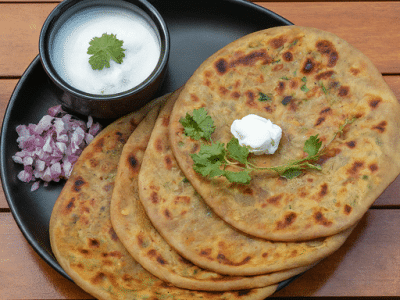
Every September, my neighbour Nirali stops buying onions. Not because she’s run out, and not because prices have spiked. Paryushan has begun, and for eight days her kitchen runs on rules that would stump most home cooks: no onion, no garlic, no potato, and on some days, no green vegetables at all.
The first year I watched her cook through it, I expected the food to turn bland and punishing. Instead I got a masoor dal khichdi so warmly spiced I asked for the recipe twice, and a raw banana curry that tasted like a discovery rather than a compromise. That’s the part most Paryushan menus online miss: the restrictions aren’t the recipe. They’re just the starting point.

Table of Contents
Key Takeaways
- Paryushan Parva 2026 runs Tuesday, 8 September to Tuesday, 15 September for Shwetambar Jains. Digambar Jains observe Das Lakshan Parva starting the same week and continuing into late September.
- The diet skips root vegetables, onion, and garlic, largely on grounds of ahimsa or non-violence, since pulling up a root is considered to disturb more soil life than picking something that grows above ground.
- Sabudana, moong and masoor dal, raw banana, and paneer do most of the heavy lifting in a Paryushan kitchen, because they’re filling without needing anything off-limits.
- Breakfast is the meal people run out of ideas for first. A little make-ahead planning, like soaking dal or roasting flour the night before, fixes that quickly.
- Corn and most fruits are generally fine to eat, though green vegetables get restricted on specific fasting days in many households. When in doubt, check with your own family’s tradition rather than a blanket rule.
If you’re the one actually cooking through the week, the philosophy behind the fast matters less by dinnertime than the question every home cook asks: what goes on the table tonight that’s filling, doesn’t taste like a punishment, and doesn’t send you hunting for a specialty ingredient at 7pm? That’s what the rest of this guide is for.
When Is Paryushan in 2026, and What Does the Fast Actually Ask of You?
Paryushan Parva 2026 begins on Tuesday, 8 September and ends on Tuesday, 15 September for Shwetambar Jains, with the closing day marking Samvatsari, the festival of forgiveness (Rudraksha Ratna, 2026). Digambar Jains observe a parallel period called Das Lakshan Parva, which begins around 15 September 2026 and runs for ten days, closing with Kshamavani, their own day of forgiveness.
The eight or ten days aren’t really about the food at all. They’re built around fasting, scripture reading, and asking forgiveness, culminating in the phrase every Jain says at the end of Samvatsari: Micchami Dukkadam, or ‘may my wrongs be forgiven.’ The dietary rules exist to support that inward focus. A kitchen that isn’t fussing over onion and garlic, the thinking goes, is a kitchen that leaves more room for everything else the festival asks of you.
| Tradition | Duration | 2026 Dates | Closing Observance |
| Shwetambar Paryushan | 8 days | 8 – 15 September | Samvatsari (forgiveness day) |
| Digambar Das Lakshan Parva | 10 days | 15 – 24/25 September | Kshamavani (forgiveness day) |
What Can You Actually Cook During Paryushan?
Paryushan diet is a sattvic vegetarian way of eating observed by Jains during the festival. It excludes root vegetables, onion, and garlic, and leans on grains, dals, dairy, and above-ground vegetables instead.
Root vegetables are avoided because pulling one out of the ground is believed to kill far more microscopic life than snapping a bean off a vine or a gourd off a creeper. Onion and garlic are set aside for a related reason: both grow underground and are also thought to heighten Rajasic tendencies like restlessness and craving, which sits awkwardly with a festival built around stillness. What’s left is a fairly wide lane to cook in: moong dal, masoor dal, chana, paneer, curd, sabudana, raw banana, seasonal gourds like lauki and tinda, and most fruits.
It’s a stricter cousin of the kind of sattvic cooking you’ll see around Buddha Purnima or the vrat food of Navratri, and if you’ve cooked through either of those, Paryushan will feel familiar rather than intimidating. If you want the fuller Jain pantry beyond just the festival week, our roundup of Jain food recipes is a good place to keep browsing.
What Should You Eat for Breakfast During Paryushan?
Breakfast during Paryushan works best when it’s planned the night before, since mornings are often given over to temple visits, pratikraman, or scripture reading rather than standing at the stove. Poha tempered with peanuts and curry leaves, rava upma loaded with vegetables, and a simple besan chilla all travel well from an ordinary weekday breakfast into a Paryushan one, since none of them need onion or garlic to taste complete. Our list of breakfast recipes without onion and garlic has ten options built for exactly this gap, and most of them come together in under fifteen minutes.
Sabudana khichdi is the other breakfast workhorse, and for good reason: it’s light, it doesn’t need refrigeration overnight, and it reheats without turning gluey if you get the soaking right. If sago is new to your kitchen, our full sabudana khichdi recipe walks through the soaking ratio that keeps the pearls separate instead of clumped.
What Are the Best Lunch and Dinner Recipes for Paryushan?
These four carry a Paryushan menu comfortably through a week without repeating themselves. Two are updates of dishes that have run on this site since 2013, tightened up for how kitchens actually work today; the other two round out the week with something creamy and something sweet-savoury.
Mixed Grain Khichdi with Peanut-Sesame Tempering
This is the kind of one-pot meal you make when you want dinner to feel substantial without touching a single forbidden ingredient. Roasting the dals before they go into the cooker is what gives the khichdi its nutty backbone; skip that step and it tastes flat.
Key Ingredients: 1/4 cup moong dal, 1/4 cup masoor dal, 2 tbsp chana dal, 1/2 cup basmati rice, 1/4 cup broken wheat, 1 tsp cumin seeds, 1 tsp coriander seeds, 1 tbsp sesame seeds, 4 whole peppercorns, 2 cardamom pods, 2 cloves, 2 tbsp ghee, turmeric, salt
- Dry roast the moong, masoor, and chana dal separately in a heavy pan until they turn a shade darker and smell nutty.
- Wash the roasted dals with the rice and broken wheat, then pressure cook with 3 cups water, turmeric, and salt for 3-4 whistles.
- While that cooks, grind the cumin, coriander, sesame, peppercorns, cardamom, and cloves to a coarse powder.
- Heat ghee in a small pan, add the ground spice mix, and let it sizzle for 30 seconds without browning.
- Fold the tempering through the cooked khichdi and let it sit covered for 5 minutes before serving with curd or a coconut chutney.
Raw Banana Curry
Raw banana takes on the texture potato usually provides in a curry, which makes this the dish most people don’t miss potato in. The trick is cooking it just past fork-tender so the edges catch a little colour in the pan.
Key Ingredients: 3 raw bananas, 1 tsp cumin seeds, 1/2 tsp turmeric, 1 tsp red chilli powder, 2 tbsp oil, a few curry leaves, salt, juice of half a lemon
- Peel the raw bananas and slit them lengthwise into halves, then cut into batons.
- Boil the batons in salted water for 6-8 minutes until just fork-tender, then drain well.
- Heat oil in a pan, add cumin seeds and curry leaves, and let them splutter.
- Add the banana pieces along with turmeric and chilli powder, and toss on medium-high heat until the edges turn golden and slightly crisp.
- Finish with lemon juice off the heat and serve with chapati or phulka.
Methi Papad Curry
This one is proof that Paryushan food doesn’t have to be gentle. Dried fenugreek seeds soften into something close to a lentil once pressure cooked, and crushed papad stirred in at the end gives the curry a savoury crunch that holds even after it cools.
Key Ingredients: 3 tbsp dried fenugreek seeds (soaked overnight), 3-4 papad, 1/2 tsp turmeric, 1 tsp coriander powder, 1 tsp red chilli powder, a pinch of sugar, 1/4 tsp asafoetida, 2 tbsp oil, salt
- Drain the soaked fenugreek seeds and pressure cook them with fresh water and a pinch of salt for 3 whistles, until soft.
- Lightly roast the papad over a low flame or in the microwave until crisp, then break into small pieces.
- Heat oil in a pan and add asafoetida, turmeric, coriander powder, and chilli powder, stirring for a few seconds so the spices don’t catch.
- Add the cooked fenugreek along with a splash of its cooking water and the sugar, and simmer for 8-10 minutes.
- Fold in the crushed papad just before serving so it stays crunchy, and eat immediately with roti.
4,451,753. That’s the entire Jain population of India recorded in the last national headcount, just 0.37% of the country’s population. (Census of India, 2011)
Quick Tomato-Cashew Paneer Sabzi
No onion, no garlic, and still creamy enough to pass for a restaurant gravy. Grinding the cashews and pumpkin seeds with the tomatoes is what gives the sauce its body without any dairy cream.
Key Ingredients: 250g paneer, 3 tomatoes, 8-10 cashews, 1 tbsp pumpkin seeds, 1 tsp coriander powder, 1/2 tsp turmeric, 1 tsp red chilli powder, 1 bay leaf, 1 inch cinnamon, 2 cardamom pods, 2 tbsp butter, salt
- Roughly chop the tomatoes and blend with the cashews, pumpkin seeds, bay leaf, cinnamon, and cardamom to a smooth paste.
- Cut the paneer into cubes and shallow fry in a little butter until light gold on the edges, then set aside.
- Melt the remaining butter in a pan, add the tomato-cashew paste, and cook on medium heat, stirring often, until it thickens and the butter starts to separate at the edges.
- Stir in turmeric, coriander powder, chilli powder, and salt, then add half a cup of water and bring to a gentle boil.
- Add the fried paneer, simmer for 5-7 minutes, and serve hot with rice or chapati.
What Sweet Suits a Paryushan Evening?
Gud Papdi
Gud papdi is the kind of sweet that comes together faster than you’d expect from how rich it tastes. Wheat flour roasted slowly in ghee until it turns the colour of light caramel is the whole secret; rush that step and the jaggery won’t have anything to cling to.
Key Ingredients: 1 cup whole wheat flour, 1/2 cup ghee, 3/4 cup grated jaggery, 1/4 tsp ginger powder, a pinch of nutmeg powder, chopped almonds and cashews, poppy seeds for garnish
- Heat the ghee in a heavy pan and add the wheat flour, stirring continuously over low heat.
- Roast until the flour turns a light golden brown and smells toasted, about 12-15 minutes; don’t rush this or the jaggery won’t melt in evenly.
- Stir in the ginger powder and nutmeg powder and cook for another 2 minutes.
- Turn off the heat and add the grated jaggery, mixing briskly until it melts completely into the flour.
- Pour the mixture onto a greased plate, press it flat, and garnish with chopped nuts and poppy seeds while still warm.
- Let it firm up for 15-20 minutes, then cut into squares.
What Should You Swap When a Recipe Calls for Onion, Garlic, or Potato?
Most everyday recipes translate into Paryushan-friendly versions with one or two substitutions. This is the swap list that comes up most often in a Jain kitchen during the festival.
| Everyday Ingredient | Common Paryushan Swap | Why It Works |
| Potato | Raw banana or a seasonal above-ground vegetable like tinda | Holds a similar texture in curries and sabzis without being a root |
| Onion and garlic | Extra asafoetida (hing) with tomato or grated coconut | Adds savoury depth and pungency without an underground ingredient |
| Regular rice-only meals | A mix of rice, broken wheat, and dal, as in mixed grain khichdi | Adds protein and variety across a week of otherwise similar meals |
“The restrictions aren’t the recipe. They’re just the starting point.”
What Foods Should You Avoid During Paryushan, and Why?
The core list stays consistent across most Jain households: potato, onion, garlic, ginger, carrot, beetroot, and radish, since all of them are root vegetables. Many families also set aside green leafy vegetables on specific days of the observance, particularly Ekasana or Ayambil days, when the rules tighten further. Fermented foods like commercial pickles are generally avoided too, partly on grounds of ahimsa around fermentation itself.
Corn, most fruits, gourds, paneer, and dairy stay on the table through the week for most families, which is why they show up so often in the recipes above. If you’re cooking for someone else’s household rather than your own, the honest answer is to ask them directly. Practice varies enough between Shwetambar and Digambar families, and even between individual households within each, that a single universal list will always miss someone’s tradition.
24 grams. That’s roughly how much protein split moong dal carries per 100g in its raw, dry form, making it one of the higher-protein pulses in an Indian kitchen. (ICMR-NIN, Indian Food Composition Tables 2017)
What Mistakes Do First-Time Paryushan Cooks Make?
- Leaning on sabudana for every meal. Dry pearl tapioca is almost pure carbohydrate, about 358 kcal and 88.7g of carbs per 100g with barely any protein (USDA FoodData Central), so pairing it with dal, paneer, or peanuts keeps the week from leaving you hungry an hour after eating.
- Skipping breakfast planning entirely. Soak your dal or roast your flour the night before, since mornings during the festival are usually busier than usual, not freer.
- Treating every day of the eight or ten as identical. Ekasana and Ayambil days carry tighter rules than an ordinary Paryushan day, so it’s worth checking your family’s calendar rather than cooking on autopilot.
- Assuming ginger is automatically allowed because it’s used so widely elsewhere. Ginger is itself a root, and many households that avoid onion and garlic skip it too, even though some don’t. Again, this comes down to family practice.
“A kitchen that isn’t fussing over onion and garlic is a kitchen that leaves more room for everything else the festival asks of you.”
Cooking Through the Week
Paryushan asks you to slow down, and a kitchen that’s genuinely thinking about restraint rather than just following a checklist tends to slow down too. You don’t need every recipe on this page to get through the eight or ten days; two or three that you can make on repeat, done well, will carry you further than a long list you never quite get to.
Start with whichever one sounds least like effort tonight. Cook it the way Nirali does: unhurried, and without treating the restraint as a punishment.
Frequently Asked Questions
Can you eat corn during Paryushan?
Corn is allowed in most Paryushan kitchens, since it grows above ground and isn’t classified as a root vegetable. Some families choose to skip fresh corn on the specific days when green vegetables are restricted, particularly Ekasana or Ayambil days, but this is a household-level choice rather than a universal rule. When you’re cooking for someone else’s family, it’s worth asking directly rather than assuming.
Can you eat raw banana during Paryushan?
Raw banana is not just allowed during Paryushan, it’s one of the most commonly used vegetables of the festival. Because it isn’t a root vegetable, it steps in wherever a recipe would normally call for potato, which is why dishes like raw banana curry appear on so many Paryushan menus.
What is the difference between Shwetambar and Digambar Paryushan?
Shwetambar Jains observe an eight-day period called Paryushan Parva, ending in Samvatsari, while Digambar Jains observe a ten-day period called Das Lakshan Parva, ending in Kshamavani. Both traditions centre on fasting, forgiveness, and a shared sattvic diet, but they follow separate calendars and slightly different rituals through the days.
Can you eat fruits during Paryushan?
Most fruits are permitted during Paryushan and are commonly eaten between meals or as part of a lighter fasting day. Root-based produce like carrot is the exception, since it falls under the same avoidance as other root vegetables. As with corn and green vegetables, some households restrict fruit intake further on specific fasting days, so it’s worth checking individual practice.
What is Paryushan Parva, and why do Jains observe it?
Paryushan Parva is an annual Jain festival built around fasting, scripture reading, and seeking forgiveness, observed for eight days by Shwetambar Jains and ten by Digambar Jains. It’s considered the most important observance in the Jain calendar, closing with Samvatsari or Kshamavani, when Jains ask forgiveness from family, friends, and community for any harm caused during the year.
image via Hindustan Times