Dahi ki Gujiya is a savoury dish that does not get nearly as much attention as it deserves. While most people associate gujiyas with sweet festival versions, this one is built around urad dal. The dal is soaked, ground to a fine paste and whipped until light, then shaped into small semi-circles around a filling of ginger, green chillies, mint and sultanas. After frying, the gujiyas rest briefly in warm salted water before being arranged in cool, cumin-spiced curd. The soft dumpling against the chilled, tangy curd makes this worth the effort.
About the Recipe
The technique here has something in common with Dahi Kofta Curry in that the dal paste must be whipped well before shaping. Skip that step and the dumplings will be dense rather than light. The muslin-stretching method for shaping the gujiyas is specific to this recipe and makes the semi-circle form much easier to achieve than folding by hand alone. The warm salted water soak after frying is not optional: it softens the outer crust and draws out excess oil so the curd coats the gujiyas cleanly.
Why You Will Love This Recipe
The filling is what sets this apart. Most dal-based dumplings use a spiced paste throughout, but here the ginger, chillies, mint and sultanas sit inside each gujiya, so every bite has a small burst of flavour the outer curd does not hint at. Texture matters here too. The soak in warm salted water after frying softens the dumpling just enough without making it fall apart, so it holds its shape in the curd. If you enjoy dishes like Dahi ki Kadhi, the cool, spiced curd element here will feel familiar.
Cooking Tips
The most common mistake is not whipping the dal paste long enough. It should look noticeably lighter and feel airy before you shape the gujiyas. If it stays heavy, the fried dumplings will be dense in the centre. Keep your hands wet throughout shaping or the paste will stick and tear. Fry on a moderate heat so the gujiyas cook through before the outside browns too quickly. Do not skip the warm salted water soak after frying.
Top Tips
- Soak the urad dal for the full 10 hours. A shorter soak produces a coarser paste that does not whip up as well.
- Grind the dal as finely as possible. Any graininess in the paste will show up in the finished texture of the dumpling.
- Wet your hands and the knife before every gujiya you shape and slide into the oil. Dry hands cause the paste to tear.
- Fry on a medium heat, not high. The gujiyas need time to cook through to the centre before the outside turns golden.
- Squeeze the soaked gujiyas gently with both hands. Pressing too hard breaks them; not pressing enough leaves excess water that dilutes the curd.
- Chill the assembled dish for at least 30 minutes before serving. The flavours settle and the curd thickens slightly around the gujiyas.
Serving and Storing Suggestions
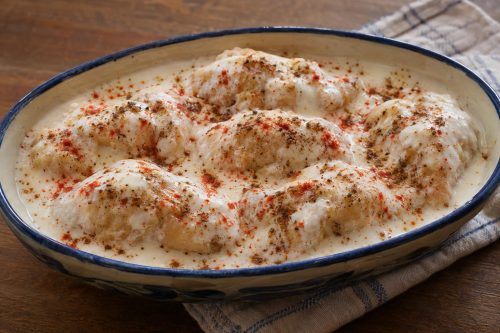
Serve Dahi ki Gujiya well chilled, with a dusting of roasted cumin powder and red chilli powder added just before bringing it to the table. It works as a starter or a light lunch on its own. Leftovers can be refrigerated for up to a day, though the gujiyas will absorb more curd as they sit. Do not freeze the assembled dish. If preparing ahead, store the fried and soaked gujiyas separately from the curd and combine just before serving.
Similar Recipes
Nutrient Benefits
Urad dal provides plant protein and dietary fibre. Curd contributes calcium and is a useful source of protein as well. Because the gujiyas are soaked and gently squeezed after frying, some of the absorbed ghee is removed, making the finished dish lighter than the frying stage might suggest.
Dahi ki Gujiya
Ingredients
- For Gujiya:
- 250 gms Husked Black Beans (Dhuli Urad Dal)
- 1/2 tsp Bicarbonate of Soda
- Asafoetida - a pinch
- 2 inch piece, finely chopped Ginger
- 2 , finely chopped Green Chillies
- 2 tsp, finely chopped Mint Leaves
- 2 tblsp Sultanas
- 500 gms, for frying Ghee
- For Dahi:
- 4 cups Curd
- 2 tsp, roasted and ground Cumin Seeds
- 1/4 tsp, powdered Red Chilli
- 1 tsp Salt
- For Garnish:
- Cumin Seeds - roasted and powdered
- Red Chilli - powdered
Instructions
- To make the gujiyas, Soak dal in cold water for 10 hours.
- Drain and grind in a fine paste.
- Mix in soda and asafoetida.
- Whip the mixture till fluffy.
- Mix the ginger, chillies, mint and sultanas.
- Keep aside.
- Heat ghee in a pan.
- Stretch a moistened piece of muslin over rim of a glass.
- Using wet hands make small balls of the mixture and flatten lightly on a muslin.
- Put a small amount of ginger mixture in the centre.
- Fold over to make a semi-circle, using the muslin.
- Gently press edges to enclose filling.
- Using a wet knife slide the guijiya carefully into hot ghee and fry till pale gold.
- Make the remaining in the same way.
- Put the fried gujiyas into a bowl of warm, salted water and leave it for 10 minutes.
- For Dahi, whip curd and add cumin, chilli and salt.
- Gently squeeze gujiyas to extract excess water and arrange in a shallow dish.
- Pour over seasoned curd to cover the gujiyas.
- Garnish with powdered cumin and red chillies.
- Serve chilled.
Sign up for our newsletter
Add Awesome Cuisine as a Preferred Source

Frequently Asked Questions
Can I use split urad dal with the skin on instead of the husked variety?
The recipe calls specifically for husked black beans, which is dhuli urad dal. The skin-on variety produces a darker paste with a slightly more earthy flavour and a different texture. For the pale, light dumplings this recipe is known for, use the husked white dal.
My dal paste is not becoming fluffy when I whip it. What am I doing wrong?
The paste needs to be ground very fine first. Any coarseness will prevent it from aerating properly. Also check that there is no excess water in the paste after grinding. Drain and grind thoroughly, then whip with a wooden spoon or by hand in a circular motion for several minutes. The paste should look lighter in colour and feel noticeably airy when it is ready.
Why do the gujiyas need to go into warm salted water after frying?
The soak softens the fried outer crust so the texture is uniformly tender rather than chewy on the outside, and it draws out excess oil from frying. Both help the final dish: the curd coats the gujiyas cleanly and the texture is consistent all the way through.
Can I bake or air-fry the gujiyas instead of deep frying them in ghee?
Deep frying in ghee is central to the texture of this recipe. The gujiyas need the hot fat to set their shape quickly and develop the pale gold exterior that softens correctly during the water soak. Baking or air-frying produces a drier crust that does not soften in the same way after soaking, so the result will be noticeably different in texture.
Can the sultanas in the filling be left out or swapped for something else?
The sultanas add occasional sweetness inside the gujiya, which contrasts with the spiced curd. You can leave them out if you prefer a fully savoury filling. Some cooks use finely chopped raisins instead. Avoid substituting with fresh fruit as the moisture content changes the filling texture during frying.