
There is a particular kind of evening everyone knows. The kind where the day has gone sideways, the traffic took an hour longer than it should have, and by the time you’re home, you don’t want to think, you just want to eat something warm. In most Indian homes, that moment has a sound: the click of the gas, the hiss of jeera hitting hot ghee, the low bubble of dal starting to soften on the stove. Nobody sits you down and explains why a bowl of khichdi at nine at night feels like being wrapped in a blanket. It just does.
Turns out, that instinct was never just comfort talking. It was chemistry.
Table of Contents
Key Takeaways
- Food genuinely shapes mood, not through magic, but through the same building blocks, amino acids, gut bacteria, and blood sugar, that Indian kitchens have quietly balanced for generations.
- Most of the body’s mood-related serotonin is actually made in the gut, not the brain, which means what you eat has a direct line to how you feel.
- Everyday staples like dal, curd, turmeric, and seasonal fruit already carry mood-supporting compounds. You do not need an imported superfood to eat well for your mood.
- Sudden sugar spikes from sweets or refined snacks tend to cause an energy crash an hour or two later, and that crash can look a lot like irritability or low mood.
- Small, steady meals built around protein and slow-release carbohydrates keep mood far more stable than skipping meals and then bingeing later.
Long work hours, unpredictable schedules, and the general noise of city life in India have made stress almost a background hum for a lot of people. It matters, then, that one of the more manageable levers for steadying your mood, what’s actually on your plate, is something you control three times a day.
10.6% of Indian adults were living with a current, diagnosable mental health disorder, according to the National Mental Health Survey conducted by NIMHANS, Bengaluru, in 2015-16.
Source: NIMHANS National Mental Health Survey, 2015-16
What Is the Real Connection Between Food and Mood?
Food affects mood because the nutrients you eat directly supply the raw material your brain and gut use to build the chemicals that regulate how you feel. It isn’t a metaphor, and it isn’t wellness marketing. Digestion, the nervous system, and your emotional state run on shared machinery, and what you feed one affects the others.
The gut-brain axis is the constant, two-way conversation between your digestive system and your brain, carried largely by the vagus nerve and the trillions of bacteria living in your gut. Digestion and mood are not separate systems that occasionally overlap. They are the same conversation, running all day, which is why a heavy, greasy meal can leave you not just bloated, but genuinely flat.
This is also why the old instinct to reach for something familiar and warm when you’re low, rather than something sharp or elaborate, has some real footing. Familiar Indian comfort food tends to be exactly the kind of slow-digesting, protein-and-carb combination this system responds well to.
Why Does Your Gut Have So Much Say in How You Feel?
Roughly ninety-five percent of the body’s serotonin, the neurotransmitter most closely tied to calm and steady mood, is produced in the gut, not the brain. The gut lining is packed with specialised cells that manufacture it constantly, and gut bacteria play a direct role in how much gets made.
About 95% of the body’s serotonin is synthesised and secreted by enterochromaffin cells lining the gastrointestinal tract, according to a peer-reviewed review published in Frontiers in Cellular Neuroscience.
Source: The Mechanism of Secretion and Metabolism of Gut-Derived 5-Hydroxytryptamine, PMC
This is exactly why fermented, gut-friendly foods matter more than they get credit for. A bowl of curd at lunch or a spoon of a well-fermented
A bowl of curd at lunch or a spoon of a well-fermented traditional Indian pickle isn’t just tradition for tradition’s sake. Both carry live cultures that support the gut bacteria your body relies on to keep that serotonin supply steady.
Which Everyday Indian Foods Actually Support a Better Mood?
You don’t need to shop differently to eat for your mood. Most of what supports steady serotonin and calmer stress hormones is already sitting in an average Indian kitchen.
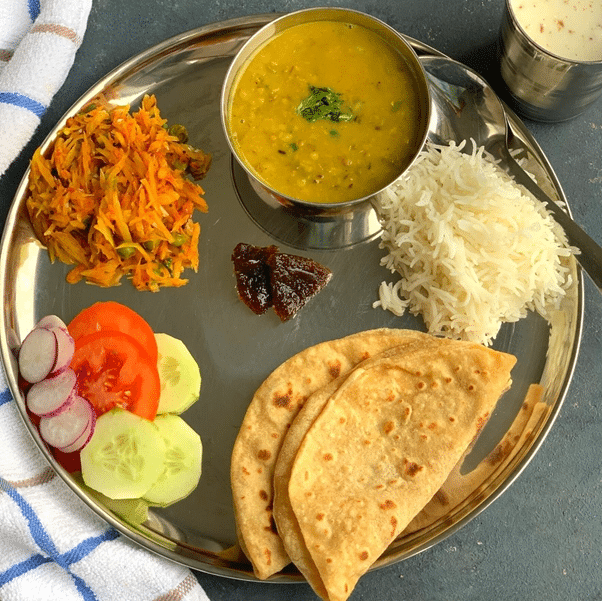
Start with dal. Lentils are rich in tryptophan, the amino acid your body converts into serotonin, and pairing dal with rice or roti gives your body the carbohydrate it needs to actually usher that tryptophan into the brain. This is precisely why dal chawal after a rough day works on you at a chemical level, not just a nostalgic one.
A good dal chawal is not just comfort food. It is your gut and your brain agreeing on something, for once.
Then there is turmeric, the spice every Indian kitchen reaches for without a second thought. Its active compound, curcumin, has anti-inflammatory properties, and chronic low-grade inflammation is increasingly linked to depressive symptoms. A pinch of haldi in your sabzi is a flavour decision more than a medical one, but the research on concentrated curcumin is genuinely promising.
A 2025 systematic review and meta-analysis of 15 randomised controlled trials, involving 1,123 adults, found that curcumin supplementation produced a significantly greater reduction in depressive symptoms than placebo.
Source: Frontiers in Pharmacology, 2025
Seasonal fruit earns its place here too. Amla, India’s richest natural source of vitamin C, helps buffer the cortisol spikes that come with chronic stress, while low-glycemic seasonal fruit like jamun releases sugar slowly enough to avoid the crash that sweeter snacks cause. And curd, eaten daily the way most Indian households already do, brings both protein and probiotics to the same plate.
You don’t need a smoothie bowl flown in from somewhere else. Your dadi’s kitchen already had most of this figured out. She just called it ghar ka khana.
How Do Low-Glycemic and High-Glycemic Indian Carbs Compare for Mood?
The speed at which a carbohydrate raises your blood sugar matters more for mood than most people realise. Slow-digesting carbs release energy steadily, which keeps serotonin production even. Fast-digesting carbs spike blood sugar quickly, and the crash that follows is where irritability, fatigue, and a sudden low mood tend to show up.
| Carbohydrate type | Common Indian examples | Typical effect on mood |
| Low-glycemic (slow release) | Brown rice, roti (whole wheat), dalia, sweet potato, most dals | Steadier energy, calmer mood over several hours |
| High-glycemic (fast release) | White rice, idli, refined maida snacks, sugar, sweets | Quick lift followed by an energy and mood dip |
Which Nutrients Matter Most, and Where Do You Find Them in an Indian Kitchen?
A handful of nutrients keep showing up across the research on food and mood. Here is where each one already lives in an Indian pantry.
| Nutrient | Role in mood | Indian food sources |
| Tryptophan | Precursor your body converts into serotonin | Dal, curd, paneer, eggs, sesame seeds |
| Omega-3 fatty acids | Anti-inflammatory, supports neurotransmitter function | Rawas, bangda, hilsa, walnuts, flaxseed |
| Curcumin (turmeric) | Anti-inflammatory; linked to reduced depressive symptoms in trials | Haldi in dal, sabzi, and doodh |
| Vitamin C and antioxidants | Helps buffer stress-hormone spikes | Amla, guava, citrus fruit |
| Magnesium | Supports nervous system regulation | Til (sesame), cashew, spinach, whole grains |
What Should You Watch Out for If You Want a Steadier Mood?
A few everyday habits quietly undo the good work of a well-balanced Indian thali.
- Skipping meals: going too long without eating drops blood sugar, and low blood sugar reads to your body as a mild emergency, which shows up as irritability.
- Leaning on sugar as comfort: a sweet fix feels good for twenty minutes, then the crash brings mood down lower than before you ate it.
- Caffeine on an empty stomach: the jitteriness that follows is often mistaken for anxiety, when it’s really just chai or coffee hitting an empty gut too fast.
- Under-eating protein while trying to eat ‘light’: protein is where your tryptophan comes from, so cutting it too aggressively can quietly starve your serotonin supply.
How Can You Build a Mood-Steady Plate at Home Tonight?
You don’t need a diet chart for this. A simple pattern works: one source of protein (dal, curd, paneer, or eggs), one slow-release carbohydrate (roti, brown rice, or dalia), something fermented or high in vitamin C on the side (curd, pickle, or a squeeze of lemon), and a spice or two, turmeric especially, worked into the cooking rather than added as an afterthought. That’s it. That’s most of a mood-supportive Indian meal, and it’s probably close to what’s already in your kitchen tonight.
Steadier moods aren’t built in one dramatic meal. They’re built in the ordinary Tuesday ones.
None of this means food will fix a hard week on its own, and if low mood is sticking around longer than a bad patch usually would, that’s worth talking to a doctor about, not just cooking through. But on an ordinary evening, when the day has been long and you’re standing in front of the fridge deciding what to make, it’s worth remembering that the instinct to reach for dal, or curd, or a spoon of pickle, isn’t just habit. Put the rice on. Let the tadka hiss for a second longer than usual. Your gut will thank you before your mood even catches up.
Frequently Asked Questions
What are mood boosting foods?
Mood boosting foods are foods whose nutrients directly support the brain chemicals and gut processes that regulate emotional state. In practice, that means tryptophan-rich foods like dal and curd, probiotic foods like fermented pickle, and anti-inflammatory ingredients like turmeric. None of them work like a switch, but eaten regularly, they give your body steadier raw material to work with.
How exactly does food affect your mood?
Food affects mood mainly through three channels: blood sugar stability, the health of your gut bacteria, and the supply of amino acids like tryptophan that your body converts into neurotransmitters such as serotonin and dopamine. A steady, balanced meal keeps all three channels calm; an erratic one, skipped, sugary, or too light on protein, tends to unsettle them.
Can turmeric actually help with low mood or anxiety?
Early clinical research suggests curcumin, turmeric’s active compound, can meaningfully ease depressive symptoms when taken as a concentrated supplement over several weeks. A pinch of haldi in your everyday cooking is unlikely to produce the same measurable effect on its own, but it’s a genuinely useful, low-risk habit to build alongside a broader mood-supportive diet.
Which Indian foods should I eat if I’m feeling anxious or low?
Warm, low-glycemic meals built around dal, curd, and seasonal fruit like amla or jamun tend to support a steadier mood better than sugary snacks or heavy fried food eaten on the run. The goal isn’t a special anxiety diet, it’s simply choosing the slower, more balanced version of what you’d normally eat anyway.
What foods should I avoid if I want a more stable mood?
Refined sugar, excess caffeine on an empty stomach, and skipped meals are the most common everyday mood destabilisers. All three trigger some version of the same blood-sugar swing, a quick high followed by a crash that shows up an hour or two later as irritability, fatigue, or a flat mood.
1 comment
Very interesting! A cup of coffee soothes my stress, in fact I take a cup of my favorite coffee before going to bed so I can sleep well.