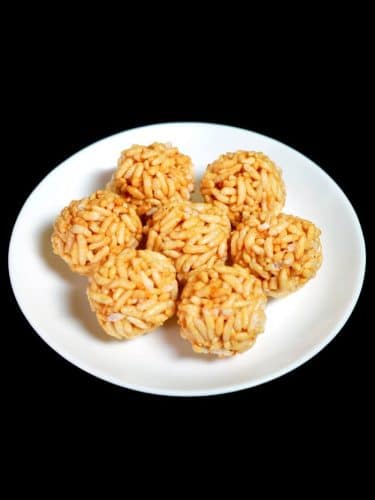
Pori Urundai is a Tamil sweet made from aval pori, which is puffed rice flakes, bound together with jaggery syrup. It is prepared during festivals like Karthigai Deepam and also made as an everyday snack.
The recipe uses dark jaggery for a deeper colour and a slightly robust sweetness that pairs well with the lightness of the pori. Peanuts, cashewnuts, roasted gram and dry coconut add bite and texture.
The whole process moves quickly once the jaggery is ready, so having everything measured and at hand before you start makes the difference between well-shaped balls and a crumbly mixture.
About the Recipe
The most important step here is cooking the jaggery syrup to the correct stage. When a small drop of syrup is placed in cold water, it should hold together as a soft, pliable ball. This is the softball stage.
If the syrup is undercooked, the balls will not hold their shape. If it goes too far, the mixture sets before you can shape it.
Straining the jaggery before the second boil removes grit and small impurities that are common in block jaggery.
Why You Will Love This Recipe
The main reason to make Pori Urundai at home is control over the jaggery stage. Store-bought versions are often either too sticky or too hard. When you cook the syrup yourself and test it properly, the balls hold together firmly but still have a slight give when you bite into them.
The combination of pori, peanuts, cashewnuts and roasted gram means each ball has a different texture in every bite. Aval pori is very light, so even a generous portion does not feel heavy.
Cooking Tips
The most common beginner mistake is not testing the jaggery syrup before adding the pori. Always drop a little syrup into cold water and check for the softball stage before taking the pan off the heat.
Once you add the pori mixture, work fast. The mixture cools quickly and becomes difficult to shape. Grease your palms lightly with ghee before rolling each ball to prevent sticking.
If the mixture cools before you finish shaping, warm it briefly over very low heat and mix gently.
Top Tips
- Measure all ingredients before starting. Once the jaggery reaches the softball stage, there is no time to weigh or prepare anything.
- Test the softball stage by dropping a small amount of syrup into a bowl of cold water. It should form a soft ball that holds its shape but is not hard.
- Grease your palms with a little ghee before shaping each ball. This prevents the mixture from sticking to your hands.
- Shape the balls while the mixture is still warm. If it begins to set, place the pan over very low heat for a few seconds and mix gently.
- Strain the melted jaggery through a fine strainer or muslin before the second boil to remove grit and impurities.
Serving and Storing Suggestions
Pori Urundai is best eaten at room temperature. Serve it as a festival offering or as a tea-time snack.
Once the balls are fully cooled, store them in an airtight container. They keep well for around five days at room temperature in a dry environment.
Avoid refrigerating them. The cold causes the jaggery to sweat and the balls turn sticky. Keep the container away from moisture.
Similar Recipes
Nutrient Benefits
Aval pori is low in fat. Peanuts and cashewnuts contribute protein and some healthy fats, while roasted gram adds a small amount of fibre and protein. Jaggery contains iron and trace minerals that refined sugar does not. Cardamom and ghee are used in small quantities, so their contribution is modest.
Pori Urundai
Ingredients
- 4 cups Aval Pori (puffed rice flakes, cleaned)
- 2 cups Dark Jaggery (grated)
- 2 tbsp Cashewnuts (fried)
- 2 tbsp Roasted Gram
- 2 tbsp Peanuts (roasted)
- 2 tsp Ghee
- 1 tsp Cardamom Powder
- 2 tbsp Dry Coconut (finely chopped, fried)
Instructions
- Combine peanuts, cashew nuts, and grated coconut with the aval pori. Set aside.
- Heat a heavy-bottomed pan over moderate heat.
- Add jaggery and enough water to cover it. Boil until the jaggery melts completely.
- Strain the jaggery to remove any impurities.
- Pour the strained jaggery into another heavy-bottomed pan or clean the old one before pouring.
- Boil for a few minutes until it reaches the softball stage.
- Remove from heat and add the aval pori mixture, cardamom powder, and ghee. Mix well.
- While the mixture is still warm, shape it into balls of desired sizes.
- Store the Pori Urundai in an airtight container once cooled.
Sign up for our newsletter
Add Awesome Cuisine as a Preferred Source

Frequently Asked Questions
Aval pori is made from flattened rice that has been puffed. It is lighter and flatter than regular puffed rice. In English it is sometimes called puffed rice flakes. It is available in most South Indian grocery stores and in larger supermarkets that stock Indian ingredients. Make sure the pori is clean and free of any husks before using it.
Keep a small bowl of cold water next to the stove. Drop a few drops of the boiling jaggery syrup into the water, wait a second, then try to gather the syrup with your fingers. If it comes together into a soft, pliable ball that holds its shape without spreading, it is at the softball stage. If it dissolves into the water, cook it a little longer. If it forms a hard ball, it has gone too far and the urundai will be very hard.
Regular puffed rice, which is rounder and lighter, can be used if aval pori is not available. The texture of the finished urundai will be slightly different as regular puffed rice absorbs the jaggery syrup differently. The shaping process and the jaggery stage remain the same either way.
This happens when the jaggery cools down before all the balls are shaped. Place the pan back on very low heat for a few seconds and stir gently until the mixture softens slightly. Working in small batches helps if you are making a large quantity. Keeping your palms greased with ghee also helps you work faster.
Stored in an airtight container at room temperature, Pori Urundai will stay fresh for around five days. Keep the container in a dry spot away from humidity. Do not refrigerate them as the moisture inside the refrigerator will cause the jaggery to become sticky and the balls to lose their shape.