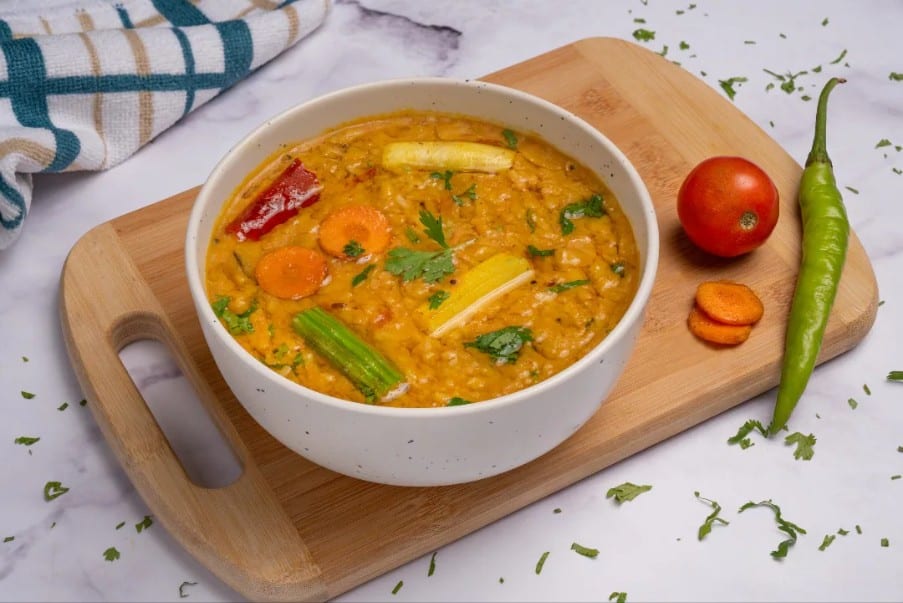
Vegetable Sambar is one of those dishes my husband and I have never fully agreed on. He grew up in a household where sambar was thin, sour, and almost broth-like. I grew up eating a thicker version, closer to a dal, where the vegetables actually hold their shape. We still argue about it.
This recipe is my version, which means the dal gets mashed properly but not pureed, and the radish is cut thick enough that you can taste it in every spoonful. The tamarind extract is the detail I am most particular about. I soak the ball for at least ten minutes, then squeeze and strain it myself rather than using the ready paste, because the flavour is noticeably different. It is a small thing, but it changes the final dish.
About the Recipe
Every ingredient here is available at a standard Indian grocery store, and nothing requires advance planning except the tamarind soak, which takes about ten minutes. The dal cooks in the pressure cooker while you prepare the vegetables, so the active time in the kitchen is closer to 30 minutes than an hour.
I make this most often on Sunday evenings when I want something substantial but do not want to start cooking at 6 pm. Pair it with plain rice and a papad, and it is a complete meal without any extra effort.
Why you will love this recipe
The radish is underrated in sambar. Most people default to drumstick or brinjal, but radish absorbs the tamarind and spice in a way those vegetables do not, and it softens without turning mushy if you keep the heat moderate. The combination of sambar powder and chilli-coriander powder also gives this more depth than a one-spice version.
You get sourness from the tamarind, earthiness from the tuvar dal, and a faint sharpness from the radish all in the same bowl. The tempering is done in a separate kadai and added at the end, which means those mustard seeds and curry leaves stay fragrant rather than cooking down into the sambar and losing their character.
Cooking Tips
The most common beginner mistake here is adding the mashed dal too early. If you mix it into the kadai while it is still on high heat, the dal settles at the bottom and scorches quickly. Transfer everything to a single pan first, reduce the heat to medium, and then stir the dal in steadily. Also watch the tamarind – too much water when straining it thins the whole sambar. I use no more than half a cup of water to soak and extract.
Top Tips
- Soak the tamarind in warm water, not cold. It softens faster and the extract is richer with less squeezing.
- Do not rush the onion. It should be light brown, not just translucent, before the radish goes in. That colour adds body to the base.
- If the sambar thickens too much on standing, add a small splash of hot water and stir before serving. Do not add cold water directly – it dulls the flavour.
- The ghee goes in near the end for a reason. Adding it too early means it cooks off. Stir it in with the sambar powder just before the final boil.
- Radish releases water as it cooks, so if yours is very fresh, saute it on medium-high heat for those two minutes rather than low, or the base will go watery.
Serving and Storing Suggestions
This recipe serves 4 people comfortably as a main with rice. Preparation takes roughly 15 minutes and total cooking time is about 35 to 40 minutes including the pressure cooker. Sambar keeps well in the refrigerator for up to two days in a covered container. Reheat it gently on the stove over low heat with a tablespoon of water added to loosen it, because it thickens considerably once cooled. I would not recommend freezing it as the radish texture changes on thawing.
Similar Recipes
- Dal Tadka
- Rasam
- Mixed Vegetable Kootu
- Drumstick Sambar
Nutrient Benefits
Tuvar dal is a reliable source of plant protein and dietary fibre, which makes this sambar more sustaining than it might look in a bowl. Radish brings in folate and vitamin C, and because it is cooked into the sambar rather than boiled separately, most of those nutrients stay in the liquid you eat. Tamarind contributes iron and tartaric acid, which actually helps the body absorb iron from the dal. For a vegetarian meal served over rice, this combination covers a reasonable nutritional range.

Vegetable Sambar
Ingredients
- Tamarind (1 lime-sized ball)
- 1 cup Tuvar Dal
- 3 flakes Garlic
- 1/4 tsp Asafoetida Powder
- 1/2 tsp Turmeric Powder
- 1/2 tsp Oil
- 4 1/2 cups Water
- 1 Onion (medium)
- 250 gms Radish
- 1 Tomato (large)
- 2 tsp Chilli-Coriander Powder
- 1 1/2 tsp Salt
- 1/4 cup Coriander Leaves (chopped)
- 1 tsp Ghee
- 2 tbsp Sambar Powder
For the Tempering:
- 2 tbsp Oil
- 1/2 tsp Mustard Seeds
- 1/2 tsp Urad Dal
- 8 Curry Leaves
Instructions
- Soak the tamarind in water.
- Wash the tuvar dal and chop the garlic.
- Place the dal in a pressure cooker separator pan with the garlic, asafoetida, turmeric, 1/2 tsp oil and 3 cups of water.
- Chop the onion, radish and tomato.
- Heat the oil in a kadai.
- Add mustard seeds and urad dal.
- Add the curry leaves.
- Add the onion and saute until it turns light brown.
- Add the radish and saute for about 2 minutes.
- Mix in the tomato and fry lightly.
- Strain in the tamarind extract and sprinkle with chilli-coriander powder.
- Boil until the mixture is well blended.
- Open the cooker and remove the pans.
- Mash the cooked dal and pour it into the pan with 1 1/2 cups of water to make a thick sambar.
- Empty the contents of the kadai into the pan and blend in the salt, coriander leaves, ghee and sambar powder.
- Cook the sambar for 3 to 4 minutes or until boiling.
- Garnish with coriander leaves
- Serve with rice.
Sign up for our newsletter
Add Awesome Cuisine as a Preferred Source

Frequently Asked Questions
My sambar turned out very thin. Where did it go wrong?
Most likely the tamarind extract had too much water in it, or the dal was not mashed thickly enough before adding. Next time, use less water when soaking the tamarind and mash the dal until it is smooth and thick before it goes into the pan. If the sambar is already thin, simmer it uncovered on medium heat for a few extra minutes to reduce it slightly.
Can I use tamarind paste from a jar instead of soaking a tamarind ball?
Yes, you can. Use about one teaspoon of tamarind paste dissolved in half a cup of water in place of the soaked extract. Taste as you go because jarred paste varies in strength and some brands are considerably more sour than a fresh tamarind ball.
My radish still tasted raw even after the sambar finished cooking. What happened?
The pieces were likely cut too thick, or the saute step was skipped too quickly. Radish needs those two minutes in the hot oil to start cooking through before the liquid goes in. Cut pieces to roughly one centimetre thickness and make sure the heat is medium-high during the saute, not low.
Can I leave out the ghee at the end?
You can skip it if you prefer a fully vegan version, but the ghee does add a distinct richness to the finish that is noticeable by its absence. A small drizzle of cold-pressed coconut oil stirred in at the end is a reasonable substitute.
The sambar tastes sour but flat, without much depth. What can I adjust?
Flat sambar usually means the tempering did not cook long enough, or the sambar powder was added too late without any cooking time. Make sure the mustard seeds pop fully before the other tempering ingredients go in, and give the sambar a full three to four minutes of simmering after all the powders are added so the spices can bloom properly in the liquid.