
Ghevar is one of the most recognisable sweets from Rajasthan, particularly associated with the Teej and Raksha Bandhan seasons. Its distinct honeycomb-like texture comes entirely from the way thin batter hits smoking hot ghee and foams upward in layers.
The technique is unlike most Indian sweets. There is no dough to mix or fold. You pour a very thin, cold batter into very hot ghee in a slow, steady stream and let the heat do the structural work. Each pour builds on the last, forming a thick, porous disc.
The famous food of Rajasthan includes many rich sweets, but Ghevar stands apart because of how it is made. The ingredients are simple. The method asks for patience and attention.
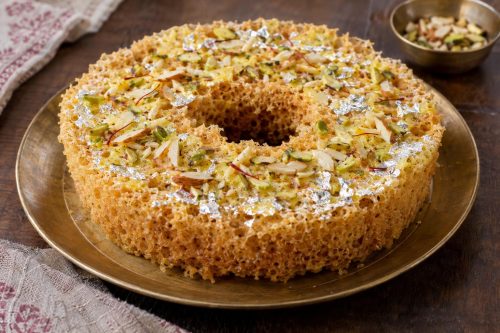
About the Recipe
The batter uses plain flour, solidified ghee worked with ice cubes until very white, milk, water and a small amount of yellow food colour. It must be thin enough to pour in a fine stream from a spoon. If it is too thick, it will not foam properly or build the layered structure that defines a good Ghevar.
Frying happens in a tall cylindrical container filled halfway with ghee. The height of the vessel matters because the batter foams up considerably on contact with hot ghee.
After frying, the disc is dipped in or drenched with one-thread sugar syrup, then finished with saffron milk, dry fruits, cardamom powder and silver foil. Each step is straightforward when taken one at a time.
Why You Will Love This Recipe
One of the more satisfying moments in making Ghevar at home is watching the batter transform. Pour it into smoking ghee in a slow, thin stream and it foams, sets and rises into a structured disc right in front of you.
Once you know what the batter should look like and how hot the ghee needs to be, there is little guesswork involved. The finished sweet is crisp on the outside and syrup-soaked within, with a topping of saffron, dry fruits and cardamom that adds fragrance and texture.
The ingredient list is short and mostly pantry staples.
Cooking Tips
The most common beginner mistake is making the batter too thick. It must be thin enough to run off a spoon in a fine, continuous stream. If it drops in blobs, add more water gradually.
The ghee must be smoking hot before each pour. If it is not hot enough, the batter will sink rather than foam.
Pour slowly into the centre of the vessel, not at the sides. Let the foam settle completely before adding the next pour, or the structure will not hold.
Top Tips
- Rub the solidified ghee with ice cubes until it turns very white before adding any other ingredient. This step affects the final texture of the batter.
- Use a tall cylindrical container of at least 12 inches height. A shallow vessel will not contain the foam and the batter will spill.
- Pour each measure of batter in one slow, unbroken stream directly into the centre hole. Stopping mid-pour or pouring at the sides breaks the structure.
- Let the foam fully settle after each pour before adding the next. Rushing this step collapses the layers.
- Have the sugar syrup hot and ready before you begin frying. Dipping a cooled Ghevar in cold syrup gives uneven absorption.
- Drain the Ghevar on a wire mesh after syrup soaking. Leaving it in pooled syrup makes the base soggy.
Serving and Storing Suggestions
Serve Ghevar at room temperature on the day it is made, when the crisp surface and syrup-soaked interior are at their best. It works well as a centrepiece sweet for Teej, Raksha Bandhan or any festive gathering.
If storing, keep it uncovered or loosely wrapped at room temperature. Covering it tightly traps moisture and softens the outer layer. Avoid refrigerating, as condensation will make it limp.
Similar Recipes
- What Are the Most Popular Rajasthan Famous Food Dishes?
- Which Famous Food of Madhya Pradesh Can You Not Miss?
- What Are the Famous Food of Haryana You Must Try?
- What Are the 25 New Years Party Food Ideas to Try This Year?
Nutrient Benefits
Ghevar is made with plain flour, ghee and milk, which together provide carbohydrates, fat and a modest amount of protein. The almond and pistachio topping adds some fat and trace minerals. This is a festive sweet, and the portion size naturally stays modest given its richness.
Ghevar
Ingredients
- 3 cups plain flour
- 1 cup solidified ghee
- 3-4 icecubes
- 4 cups water, approx.
- 1/2 cup milk
- 1/4 tsp . yellow food colour
- 1 kg . Ghee for deep frying
- For syrup:
- 1 1/2 cups sugar
- 1 cup water
- For topping: (optional)
- 1 tsp . powdered cardamom
- 1 tbsp . chopped almonds & pistachios
- 1 tbsp . milk mixed with 1/2 tsp saffron
- Silver foil
Instructions
- Prepare sugar syrup of 1 thread consistency.(Refer features for procedure of syrup)
- Take solidified ghee in a large wide bowl.
- Taking one icecube at a time rub the ghee vigourously.
- Take more icecubes as required, till ghee becomes very white.
- Add milk, flour and 1 cup water.
- Mix to make smooth batter.
- Dissolve colour in some water and add to batter.
- Add more water as required.
- Batter should be fairly thin (it should run offeasily when pour from spoon).
- Take an aluminium or steel cylindrical container (do not use lid).
- The height should be at least 12". And diameter 5-6".
- Fill half with ghee. Heat.
- When ghee is smoky hot, take a 50 ml, glassful of batter.
- Pour in centre of ghee, slowly in one continuous threadlike stream.
- Allow foam to settle. Pour one more glassful in hole formed in centre.
- When foam settles again, loosen ghevar with an iron skewer inserted in hole.
- Lift carefully, at a slant, and place on wire mesh to drain.
- Keep hot syrup in a wide flatbottomed container to fit in ghevar.
- Dip ghevar in it, and remove, keep aside on mesh to drain excess syrup .
- Alternatively. Pour some syrup evenly all over, keeping ghevar in a mesh placed over a container.
- Cool a little, top with silver foil.
- Splash a few drops of saffron milk, sprinkle some chopped dryfruit and a few pinches of cardamom powder.
Sign up for our newsletter
Add Awesome Cuisine as a Preferred Source

Frequently Asked Questions
Why is it important to use a tall cylindrical container for frying Ghevar?
When thin batter hits smoking hot ghee, it foams up quickly and rises several inches above the surface. A container shorter than 12 inches will not contain this foam and the batter will overflow. The cylindrical shape also helps the batter settle into a neat round disc rather than spreading out unevenly.
What does one-thread consistency mean for the sugar syrup, and how do I check it?
One-thread consistency means the syrup has cooked to a point where a small drop taken between your thumb and forefinger forms a single thread when you pull them apart slowly. If the thread breaks immediately, the syrup needs more cooking. If it forms two or more threads, it has gone too far. Keep the syrup warm when soaking the Ghevar.
My batter keeps sinking into the ghee instead of foaming. What went wrong?
The most likely cause is that the ghee was not hot enough. It needs to be smoking hot before each pour. If the ghee has cooled between batches, heat it again until it smokes before adding more batter. Also check that your batter is thin enough, as thick batter sinks rather than foaming upward.
Can I skip the yellow food colour in this Ghevar recipe?
Yes, the food colour is used only for appearance and does not affect the taste or texture. The Ghevar will still cook and set correctly without it. If you prefer a natural colour, a pinch of turmeric dissolved in a little water gives a pale yellow shade, though it will add a very faint flavour.
How do I know when the Ghevar is cooked through and ready to lift out?
Insert an iron skewer or thin rod into the hole that forms in the centre of the disc. When the Ghevar is ready, it will feel firm and loosen from the sides of the vessel without breaking. Lift it carefully at a slant so the ghee drains back into the container. If it still feels soft or fragile, leave it in the hot ghee for another minute before removing.

what a recipe, very good. i like ghevar.