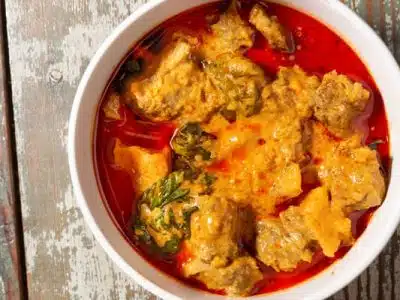
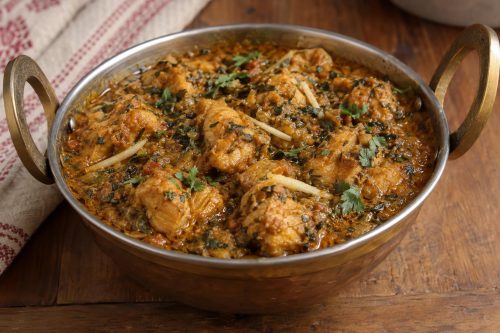
Murgh Kasoori is a North Indian chicken curry where fenugreek, known as kasoori methi, does the real work. The name itself points to the ingredient that defines this dish. Boneless chicken pieces are first marinated in whisked yoghurt, then cooked with a layered spice base of whole cardamoms, cloves, cinnamon, bay leaves and caraway seeds before a tomato gravy is built around them. What sets this apart from a standard murgh curry is the use of both fresh fenugreek leaves cooked into the gravy and dry fenugreek leaves stirred in at the end. Together they give Murgh Kasoori its recognisable flavour.
About the Recipe
The recipe builds in two parts. The first is the spice base, where whole spices are bloomed in oil before aromatics and ground powders go in with a splash of water. The tomatoes are then cooked down until the oil separates, which tells you the masala is ready for the chicken.
The second stage is the fenugreek finish. If you are using fresh fenugreek leaves, they go in with the chicken during simmering. Dry fenugreek leaves are added only at the very end along with mace powder and garam masala, then the pan is covered for five minutes on a low flame.
Why You Will Love This Recipe
The strongest reason to make this recipe is the fenugreek combination. Most chicken curries use one or the other, but using both fresh and dry fenugreek in the same dish gives you a depth that a single addition cannot match. The fresh leaves soften into the gravy during simmering and turn mild, while the dry leaves added at the end keep a sharper, more concentrated flavour.
The yoghurt marinade also does genuine work here. Thirty minutes is enough to tenderise the boneless chicken so it stays moist through the simmering stage. The result is a gravy that is thick, aromatic and clings well to the chicken.
Cooking Tips
The most common beginner mistake is adding the chicken before the oil separates from the tomato masala. If you move too quickly, the gravy will taste raw. Watch for the oil pooling at the edges of the pan before you proceed.
Add the ground spice powders with water rather than directly into dry oil to prevent scorching. When using fresh fenugreek, add it with the chicken so it has time to cook through. Dry fenugreek goes in only at the end.
Top Tips
- Whisk the yoghurt smooth before mixing it with the chicken so it coats evenly and does not split during cooking.
- Add the turmeric, coriander and red chilli powders with the measured water as instructed. This prevents the ground spices from burning on the base of the kadai.
- Do not rush the tomato stage. Cook on low heat until the oil clearly separates before adding the marinated chicken.
- If using fresh fenugreek leaves, add them with the chicken during simmering, not at the end. Dry fenugreek leaves go in only after the chicken is cooked.
- Keep the flame low for the final five-minute covered rest after adding mace and garam masala. This lets the flavours settle without the spices losing their fragrance.
- Julienned ginger added at the end is a garnish as well as a flavour element. Do not skip it as it lifts the finished dish considerably.
Serving and Storing Suggestions
Murgh Kasoori is best served hot, straight from the kadai, garnished with the julienned ginger and chopped green coriander as the recipe specifies. It pairs well with plain steamed rice, jeera rice, roti or naan.
Leftovers keep well in a sealed container in the refrigerator for up to two days. Reheat gently on a low flame with a splash of water to loosen the gravy. The fenugreek flavour deepens slightly on the second day, which many people prefer. Avoid reheating more than once.
Similar Recipes
- Murgh Mumtaz (Chicken Cooked in Tomato Gravy)
- Murgh Bemisal
- Dum ka Murgh
- Handi Murgh
- Murgh Badam Pasanda
Nutrient Benefits
Chicken is a good source of protein, which supports muscle maintenance and keeps you feeling full. Fresh and dry fenugreek leaves both contribute iron and some B vitamins. Yoghurt used in the marinade adds calcium and a little extra protein. Served alongside a whole grain bread or rice, this makes a reasonably balanced main course.

Murgh Kasoori
Ingredients
- Chicken – 1 kg, boneless, cut into pieces
- Yoghurt – 1 1/4 cups, whisked
- Salt to taste
- Oil – 3/4 cup
- Green Cardamoms – 10
- Black Cardamoms – 2
- Cloves – 8
- Cinnamon Sticks – 2
- Bay Leaves – 2
- Caraway Seeds – 1/2 tsp
- Onion – 1 tbsp, chopped
- Garlic – 6 tsp, chopped
- Ginger – 3 1/2 tbsp, chopped
- Green chillies – 3 tsp, deseeded, chopped
- Turmeric Powder – 1 tsp
- Coriander Powder – 1 1/2 tsp
- Red Chilli Powder – 2 tsp
- Water – 1 1/4 cups
- Tomatoes – 3/4 cup, chopped
- Dry Fenugreek Leaves – 3 tsp
- Fresh Fenugreek Leaves – 1 cup
- Mace Powder – 1 tsp
- Garam Masala Powder – 2 tsp
- Ginger – 2 tsp, julienned
- Green Coriander – 1 tbsp, chopped
Instructions
- Mix the chicken with the yoghurt and salt. Set aside to marinate for 30 minutes.
- Heat the oil in a kadai: add the green and black cardamoms, cloves, cinnamon sticks and bay leaves.
- Saute for a few minutes.
- Add the caraway seeds and onions and fry until golden brown.
- Add the garlic, ginger and green chillies and fry for a few more minutes.
- Now, add the turmeric, coriander and red chilli powders with 4 tbsp of water.
- Stir thoroughly.
- Add the tomatoes and fry over low heat until the oil comes to the surface.
- Add the marinated chicken and the remaining water.
- Bring to a boil, cover and simmer until the chicken is cooked. (in case fresh fenugreek is used, cook with the chicken.)
- Stir in the dry fenugreek leaves, mace powder, garam masala and ginger.
- Cover and cook on a low flame for 5 minutes.
- Serve hot, garnished with green coriander.
Sign up for our newsletter
Add Awesome Cuisine as a Preferred Source

Frequently Asked Questions
Can I use bone-in chicken instead of boneless for Murgh Kasoori?
Yes. Bone-in chicken pieces work well here, but you will need to increase the simmering time. They typically take 35 to 45 minutes to cook through on a low flame compared to around 20 to 25 minutes for boneless. Make sure the chicken is fully cooked before adding the dry fenugreek leaves and finishing spices. The gravy will also be slightly richer with bone-in pieces.
What if I cannot find fresh fenugreek leaves?
The recipe already accounts for this. If fresh fenugreek leaves are not available, use only the dry fenugreek leaves and add them at the end as instructed. The flavour will be more concentrated and slightly more bitter, so start with the stated quantity and adjust to your taste. Do not substitute with fenugreek seeds as they are much stronger and will make the dish unpleasantly bitter.
Why does the recipe ask me to add water with the ground spice powders?
Ground spices, especially turmeric and red chilli powder, can burn quickly in hot oil. Adding four tablespoons of water along with the powders creates enough moisture to prevent scorching while still allowing the spices to cook into the masala properly. If you skip the water, the spices can turn bitter and leave a harsh taste in the finished gravy.
How do I know when the tomato masala is ready for the chicken to be added?
The clearest sign is oil separating and pooling at the sides and surface of the masala. The tomatoes will have broken down completely and the mixture will look darker and more paste-like rather than wet and saucy. This usually takes around 8 to 12 minutes on a low flame. Adding the chicken before this point will leave a raw masala taste in the finished dish, so it is worth waiting.
Can I marinate the chicken for longer than 30 minutes?
Yes. Marinating for up to four hours in the refrigerator will give you slightly more tender chicken. If you plan to marinate for longer than 30 minutes, cover the bowl and keep it refrigerated, then bring the chicken back to room temperature for about 15 minutes before cooking so it cooks evenly. Marinating overnight is not recommended for boneless chicken as the yoghurt can make the texture a little mushy.