The water in the saucepan has barely settled into a boil when the macaroni goes in, and within a minute the surface turns cloudy and thick. The pieces at the bottom fuse into a loose raft, so you stir hard, the raft breaks, and ten minutes later the pasta comes out soft at the edges and chalky at the centre. The packet was fine and so was the sauce, but the pot was too small for the job.
Cooking pasta looks simple enough that few people question it, and many home recipes still carry habits that pasta makers advise against, such as a splash of oil in the water or a cold rinse before serving. This guide sets out what two Italian pasta makers print on their own pages, where they disagree, and how to adapt the advice to the vessels, stoves and masala-based cooking that many Indian kitchens work with.
Key Takeaways
- Pasta needs a large vessel with about one litre of water for every 100 grams, so a family packet calls for a bigger pot than most kitchens use for rice.
- Salt goes into the water once it is boiling, and the two pasta makers reviewed here give slightly different amounts, so treat the figure as a range and taste the water.
- Oil in the water and a cold rinse are habits that makers and chefs advise against for hot pasta, with one accepted exception: pasta for a cold salad can be rinsed.
- Al dente pasta is firm to the bite, and laboratory work suggests it is digested more slowly than fully cooked pasta, although that finding has not been tested for health outcomes in people.
- Moving the drained pasta into the sauce pan with a ladle of the cooking water gives a sauce that clings, which follows the same logic as bringing a masala together with a splash of water.
- Shape and sauce work as a pair, and the shape table below gives a starting point that similar shapes can share.
Pasta cooks quickly, which means the decisions that matter are made in the first five minutes: the size of the pot, the amount of water, and the moment the salt goes in. Each of them costs nothing to change, and the sections below show how to set them for a family-sized batch, how to judge doneness, and how to finish the pasta so the sauce holds on.
How Much Water and Salt Do You Need to Cook Pasta?
Plan on about one litre of water and between 7 and 10 grams of salt for every 100 grams of dry pasta. Barilla gives 7 grams and Granoro gives 10, so the salt amount is a range, and tasting the water before the pasta goes in settles where you land within it.
Barilla states that cooking 100 grams of pasta takes, on average, 1 liter of water and 7 grams of salt, which it equates to about a teaspoon of fine salt. Source: Barilla, Classic Blue Box Spaghetti product page, barilla.com (UK), accessed October 2026
Granoro, another Italian maker, prints a different salt figure in its cooking tips: 10 grams of salt and 1 litre of water per 100 grams of pasta. The gap is 3 grams per litre, which is small in a kitchen where salt is judged by the pinch. If you watch your sodium, start at the lower figure, because the sources reviewed here do not report how much of the salt ends up in the pasta itself. Barilla also adds the salt only after the water is boiling and the pasta after that, with occasional stirring.
The table below converts the two figures into amounts for common packet sizes. These numbers are calculated here from the 1 litre and 7 or 10 gram guidance, so they are approximations, and a teaspoon of salt varies from one set of spoons to another.
| Dry pasta | Water | Salt at 7 g per litre (Barilla) | Salt at 10 g per litre (Granoro) |
| 100 g | 1 litre | 7 g | 10 g |
| 200 g | 2 litres | 14 g | 20 g |
| 400 g | 4 litres | 28 g | 40 g |
| 500 g | 5 litres | 35 g | 50 g |
A 400 gram packet therefore needs about four litres of water, which leaves little headroom in a 5 litre vessel once the pasta goes in, so choose something larger. A wide steel patila, or the pot of a large pressure cooker used without its lid, can hold that volume where a small saucepan cannot.
What Does Al Dente Mean, and How Do You Get There?
Al dente describes pasta that is cooked through but still firm to the bite. To get there, follow the time on the packet for that shape and start tasting a minute or two before it ends, because stoves, vessels and the thickness of the pasta all shift the timing.
Al dente is an Italian cooking term, literally “to the tooth”, for pasta that is cooked through but still slightly firm at the centre when bitten. The texture sits between crunchy and soft.
Granoro advises tasting the pasta and following the time printed for each shape, and the cooking teacher behind Seasoned Kitchen starts testing about two minutes before the earliest time on the packet. Saga, a UK publisher, notes that most dried pasta takes 8 to 12 minutes and that the packet gives the actual figure. Pasta keeps cooking in the pan and on the plate, so it helps to drain it while it is slightly firmer than you want to eat it, particularly when it will finish in a hot sauce.
A 2022 laboratory study of durum wheat spaghetti reported that “cooking time had a large impact on pasta starch digestion”, and that cooking to al dente instead of fully cooked reduced the extent of starch digestion. The digestion was measured in vitro, in laboratory tests, and not in people. Source: Sissons M, Cutillo S, Egan N, Farahnaky A, Gadaleta A, Foods, 2022
A tidy chain suggests itself here: shorter cooking leaves the starch less swollen, less swollen starch digests more slowly, slower digestion flattens the rise in blood glucose, and a flatter rise is better for health. Measurements stop partway along that chain. The Sissons study tested digestion in the laboratory, so it cannot say what happens in a person’s blood, and a firmer pasta might also be eaten in a different portion or alongside different foods. The human trial in the next section tested cooling and reheating, not boiling time. What the evidence shows is a laboratory difference between al dente and fully cooked spaghetti, and whether that difference matters for any individual’s health remains unestablished by these sources.
Does Reheated Leftover Pasta Affect Blood Sugar Differently?
One randomised cross-over trial found that pasta eaten after being cooled and reheated produced a lower blood glucose response than the same pasta eaten freshly cooked, by roughly 4 per cent on the area under the curve. Pasta cooled and eaten cold did not differ significantly from hot pasta, and the finding comes from a single study.
In a randomised cross-over trial in which participants ate three identical pasta meals (hot, cooled and reheated) in random order, blood glucose area under the curve was 703 ± 56 for reheated pasta and 735 ± 77 for hot pasta, in mmol per litre per minute, with the cold condition at 722 ± 62 and not significantly different. Blood glucose was measured before each meal and every 15 minutes for 120 minutes afterwards. Source: Hodges C, Archer F, Chowdhury M, Evans BL, Ghelani DJ, Mortoglou M, Guppy FM, Foods, 2019
The gap between 735 and 703 works out to about 4 per cent, a figure calculated here from the two reported averages. The authors describe changes in starch structure as the most likely explanation for the difference, which makes it a proposed mechanism and not a demonstrated one, and one trial is too little to set cooking rules around. For a lunchbox, our Indian style vegetable pasta recipe suggests keeping leftovers in an airtight container in the fridge for up to 2 days and reheating gently with a splash of water.
Should You Add Oil to the Water or Rinse Cooked Pasta?
For hot pasta, the sources reviewed here say no to both. Oil floats on top of the water and mostly leaves with it, and a cold rinse washes off the surface starch that helps a sauce cling. Pasta headed for a cold salad is the one case where rinsing is accepted.
The table below sets out three habits that appear in many home recipes, the reasons cooks give against them, and the cases where they are acceptable.
| Common habit | Why cooks advise against it | When it is acceptable |
| Oil in the boiling water | Barilla Australia’s executive chef says oil stays on top and is tipped out with the water, and Saga says oil coats the pasta so the sauce does not stick. | Pastas Gallo calls a little oil optional for some long and fresh pasta, so makers do not all agree. |
| A cold rinse after draining | Rinsing removes the surface starch that lets the sauce stick, according to Saga. | Pasta for a cold salad, where both Saga and Falstaff accept it to stop clumping. |
| Pouring away all the cooking water | The starchy water loosens a sauce and helps it bind, which Falstaff calls essential for oil-based sauces. | A thin sauce that needs no loosening. |
The same pasta needs a different ending depending on whether it is headed for a hot pan or a cold lunchbox.
Great Italian Chefs lists putting pasta into warm water before it boils among the myths to avoid, and Barilla’s own instructions put the pasta into water that is already at a rolling boil.
How Do You Finish Pasta in the Sauce?
Lift the pasta into the pan holding the sauce, add a ladle of the starchy cooking water, and toss until the sauce coats the strands. The starch in the water helps the sauce bind, and the idea is the same as bringing a masala together with a splash of water.
Barilla Australia’s executive chef, Andrea Tranchero, advises keeping a ladle of cooking water back before draining, and Falstaff recommends reserving about a cup. The Daily Meal adds a point about order: start the sauce before the pasta, because pasta left waiting in a colander can stick and dry out.
Masala-style pastas follow a similar order. In our Indian style vegetable pasta, the vegetables are sautéed first and the drained pasta goes into that pan, with a splash of pasta water if the dish looks dry. If you make your own sauce, our homemade pasta sauce asks you to simmer until the raw smell of the tomatoes is gone before the pasta meets it.
Which Pasta Shape Suits Which Sauce?
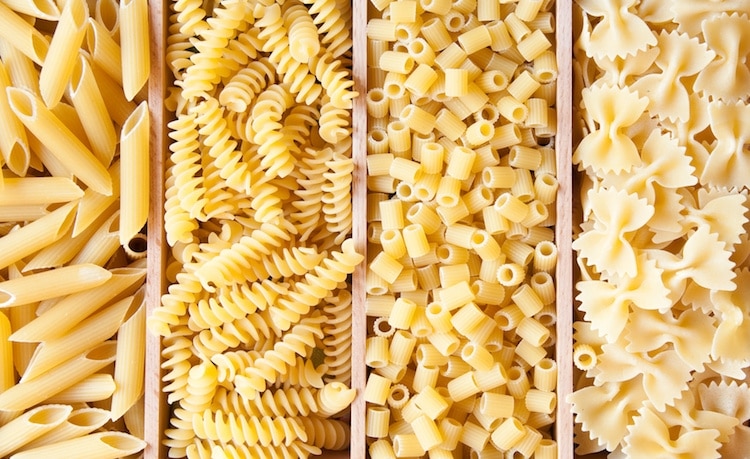
Long thin shapes suit sauces that coat the strand, ribbons suit rich or creamy sauces, and tubes, twists and shells suit chunkier sauces that settle into their hollows and curves. Cooks apply these pairings loosely, and similar shapes can stand in for one another.
| Shape family | Common shapes | Sauces they are paired with |
| Long and thin | Spaghetti, linguine, bucatini | Oil-based sauces such as aglio e olio and pesto, light tomato sauces, and creamy sauces such as carbonara |
| Long ribbons | Tagliatelle, fettuccine, pappardelle | Rich meat sauces and cream sauces |
| Tubes | Penne, rigatoni, macaroni | Cheesy, meaty and chunkier tomato sauces, and baked pasta dishes |
| Twisted | Fusilli, farfalle | Chunky sauces and pesto, and cold pasta salads |
| Shells | Conchiglie, orecchiette | Creamy, cheesy, vegetable and meaty sauces that can collect in the cup |
The pairings above draw on Pasta Evangelists, EHL Hospitality Insights and The Reluctant Gourmet, and a food writer at Carrots and Tigers makes the point that similar shapes can be swapped while personal taste decides. Our Alfredo vs Carbonara guide lists the shapes that suit each of those two sauces.
How Much Pasta Belongs on the Plate?
A common main-course portion is 75 to 100 grams of dry pasta per adult, and the dry weight is the number to measure, because cooked pasta weighs roughly 2.3 times as much once it has absorbed water. Vegetables, paneer or another protein in the pan keep the pasta from carrying the whole plate.
Saga suggests 75 to 100 grams of dried pasta per person for a main meal. The 2.3 times figure is an approximation derived from USDA FoodData Central energy values of about 371 kilocalories per 100 grams for dry enriched pasta and about 158 for cooked enriched pasta, on the assumption that cooking adds water and no energy, and brands and shapes vary. Our pasta portion calculator separates adult and child portions and adjusts for dry, fresh and filled pasta.
The pasta is the base of the plate, and what goes into the pan beside it decides how balanced the meal turns out.
Pasta is a wheat product, so it belongs to the cereals group, and ICMR-NIN’s What India Eats report found that cereals supplied 51 per cent of energy for urban adults and 65.2 per cent for rural adults, while its executive summary says that “not more than 45% of energy should be contributed by cereals and millets” (other tables in the same report use a ceiling of 40 per cent). The report draws on NNMB surveys from 2012 for rural India and 2016 for urban India and describes average diets, so it says nothing about any one household’s pasta night. It is a reasonable prompt to give vegetables as much room in the pan as the pasta, and a protein such as the paneer in our paneer pasta fills out the plate.
What Makes Pasta Sticky, Soft or Bland?
The sources reviewed here link sticky pasta to too little water or too little stirring when the pasta goes in, soft pasta to cooking past the packet time, and bland pasta to water that was not salted enough. All three are easy to correct on the next batch.
Falstaff lists too little water, under-salted water and overcooking among the most common mistakes, and adds that salt added after cooking does not do the same work as salt in the water. Great Italian Chefs says to stir as the pasta goes in so the pieces do not clump, and Saga advises against cooking different shapes or brands in the same pot because their timings differ.
Cook Two Shapes, One Sauce
Make one pot of sauce next time and cook two shapes in separate vessels, penne and spaghetti for instance, then serve them side by side. The shape table above gives a starting guess, and your own plates will show which pairing your household finishes first.
Frequently Asked Questions
How much water do you need to cook pasta?
Barilla and Granoro both give about one litre of water per 100 grams of dry pasta. A 400 gram family packet therefore needs roughly four litres, which only a large vessel holds comfortably, and Saga warns that a smaller volume leaves the pasta sticky.
Should you put oil in pasta water?
Most of the sources reviewed here advise against it. One Spanish maker, Pastas Gallo, calls a little oil optional for some long and fresh pasta, so a spoonful is a matter of preference and plenty of water and stirring do more to keep strands apart.
How long does pasta take to cook?
Most dried pasta takes about 8 to 12 minutes in boiling water, and the time printed on the packet for your shape is the figure to follow. Fresh pasta cooks faster because it starts with more water. Taste a piece shortly before the end to catch it at the firmness you like.
Can you rinse pasta after cooking?
Rinse only pasta that is going into a cold salad, where it stops the pieces from clumping. Hot pasta goes straight from the colander into the sauce while its surface starch is still on it.
Can you cook pasta with the heat off?
Barilla’s product page describes cooking pasta with a lid on so that it continues to cook after the heat is turned off, and states savings of up to 80 per cent in energy use and emissions, a figure that is the company’s own and was not checked independently here. Timings change with the shape and the vessel, so taste early and often the first time you try it.
Sources and Further Reading
- Classic Blue Box Spaghetti, product page (UK), barilla.com, accessed October 2026.
- How to cook pasta, Recipe book, granoro.it, accessed October 2026.
- Sissons M, Cutillo S, Egan N, Farahnaky A, Gadaleta A. Influence of Some Spaghetti Processing Variables on Technological Attributes and the In Vitro Digestion of Starch. Foods, 2022;11(22):3650.
- Hodges C, Archer F, Chowdhury M, Evans BL, Ghelani DJ, Mortoglou M, Guppy FM. Method of Food Preparation Influences Blood Glucose Response to a High-Carbohydrate Meal: A Randomised Cross-over Trial. Foods, 2019;9(1):23.
- ICMR-National Institute of Nutrition. What India Eats, nin.res.in, accessed October 2026 (executive summary; NNMB Rural Survey 2012 and NNMB Urban Survey 2016).
- USDA FoodData Central. Pasta, dry, enriched (FDC ID 169736) and Pasta, cooked, enriched, without added salt (FDC ID 169737).
- Good Food. A top chef’s tips for cooking perfect dried pasta every time, 25 February 2019.
- How to cook pasta, saga.co.uk, accessed October 2026.
- Great Italian Chefs. How to cook perfect pasta, 28 July 2016.
- The most common mistakes when cooking pasta, falstaff.com, accessed October 2026.
- Pastas Gallo. 8 tips to cook pasta, pastasgallo.es, accessed October 2026.
- The Daily Meal. How to cook pasta perfectly, thedailymeal.com, accessed October 2026.
- Seasoned Kitchen. Perfect pasta every time, seasonedkitchen.com, accessed October 2026.
- Pasta Evangelists. How to pair your pasta with the perfect sauce, accessed October 2026.
- EHL Hospitality Insights. Pasta shapes, insights.ehl.edu, accessed October 2026.
- The Reluctant Gourmet. Match your pasta shape to the perfect sauce, reluctantgourmet.com, accessed October 2026.
- Carrots and Tigers. Why the shape of your pasta matters, 17 October 2024.
- Consorzio Tutela Grana Padano. Cooking pasta in boiling water, granapadano.it, accessed October 2026.