Break open a hot litti and the crust cracks like dry earth. Steam rises, a spoonful of ghee goes in, and the sattu inside, dry and nutty and sharp with mustard oil, drinks it up within seconds. Someone passes a bowl of chokha, a coarse mash of charred brinjal, tomato and potato, and the plate is complete without a long list of spices.
This is the cooking of the Bhojpur-Purvanchal belt, the stretch of western Bihar, eastern Uttar Pradesh and north-western Jharkhand where Bhojpuri is spoken. It was built for people who worked outdoors from sunrise, so it favours food that carries energy, keeps well and depends on a few strong ingredients. Most guides stop at litti chokha. The wider cuisine includes steamed dumplings, fried rice-and-lentil pancakes, mustard-laced fish, and festival offerings cooked without salt, onion or garlic.
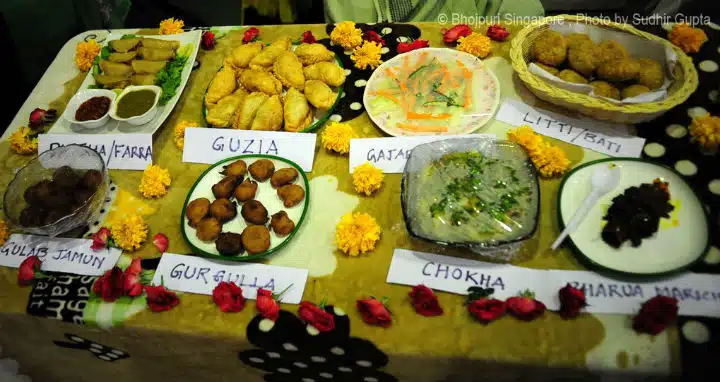
Table of Contents
Key Takeaways
- Bhojpuri cuisine is the home cooking of western Bihar, eastern Uttar Pradesh, north-western Jharkhand and the Terai of Nepal, built on staples including wheat, rice, pulses, seasonal vegetables and mustard oil.
- Sattu, a flour of roasted Bengal gram that can be eaten without further cooking, sits at the centre of the kitchen, in litti, in parathas and in a cooling summer drink.
- Flavour comes from raw mustard oil, garlic, green chillies and pickle masala, so the food is gentle on spice blends but sharp in aroma.
- Litti chokha, sattu paratha, dal pitha, dhuska with ghugni, kadhi bari and thekua define the everyday and festival table, and meat and fish curries sit alongside them.
- Chhath, the four-day sun festival, produces the region’s most ritual food, cooked on earthen stoves without salt, onion or garlic.
- Chokha and dal puri appear in Mauritius and the Caribbean, where indentured workers from Bihar and its neighbouring provinces settled in the nineteenth century.
The weeks after Diwali bring Chhath, so this is a good time to look at the food around that festival and the kitchen it comes from.
Bhojpuri cuisine is the regional home cooking of the Bhojpuri-speaking people of western Bihar, eastern Uttar Pradesh, north-western Jharkhand and the Terai of Nepal. It is built on wheat, rice, pulses, seasonal vegetables, mustard oil and sattu, and it is generally milder in spice than the cooking of neighbouring regions (Wikipedia).
Where Does Bhojpuri Cuisine Come From?
Bhojpuri cuisine comes from the Bhojpur-Purvanchal region, which covers western Bihar, eastern Uttar Pradesh and north-western Jharkhand in India and the Terai of Nepal (Wikipedia). It sits between Awadh in the west and Mithila in the east, so it borrows from both while keeping staples of its own (30 Stades).
Bhojpuri is the mother tongue of 5,05,79,447 people in India, according to the 2011 Census figure that the Ministry of Home Affairs gave the Lok Sabha on 16 March 2021. The Census lists Bhojpuri among the mother tongues grouped under Hindi, so the community may be larger than the count suggests. Source: Ministry of Home Affairs, Lok Sabha Starred Question 292 (2021)
Five crore speakers do not share a single menu. Bihari cuisine is usually described as four regional strands, Angika, Bhojpuri, Maithil and Magahi (Wikipedia), and our guide to 18 Bihar food delights covers the state-wide picture. This article stays with the Bhojpuri strand, whose western neighbour is the Awadhi kitchen. That influence shows in dishes including pulao, biryani and raita, which turn up in Bhojpuri meals alongside puri-sabzi and kachori (30 Stades). For the Lucknow side of that border, see our piece on Awadhi cuisine.
Three Strands of Bihari Cooking
| Strand | Where it sits | What leans heavily | Dishes and ingredients named in sources |
| Bhojpuri | Between Awadh in the west and Mithila in the east | Awadhi influence, wheat, sattu | Litti chokha, sattu paratha, pulao, biryani, raita, puri-sabzi |
| Magahi | Central Bihar, including Patna, Nalanda and Gaya | Rice first, then wheat and maize | Lentils, jaggery, mustard seeds |
| Maithil | North Bihar, bordering Nepal | Rice, dals, fish, meat and dairy | Dahi chuda, kumhrauri, tisauri, irhar |
Sources: 30 Stades; Cuisine India Society.
What Makes Bhojpuri Food Different From Other North Indian Cooking?
Three things set Bhojpuri food apart from the rest of the North Indian table: sattu eaten as a ready-to-eat staple, raw mustard oil used as a flavour in its own right, and chokha, a family of mashed vegetables roasted over fire. Spice blends play a smaller role than the sharpness of mustard oil, garlic and green chilli.
Sattu is a flour made by dry-roasting grains or pulses and grinding them. In Bihar and eastern Uttar Pradesh the grain is usually Bengal gram, while barley is preferred in other parts of Uttar Pradesh and barley and maize in Punjab, according to a 2022 sattu formulation study by Shakeb, Dharanya and Pandey. Because the gram is roasted before it is ground, the flour can be stirred into water, shaped into a stuffing or kneaded into a drink with no further cooking.
Besan is raw gram ground to flour. Sattu is gram roasted first, which is why it can be stirred into water and eaten.
Besan, by comparison, is ground from unroasted gram (SBI General). A litti stuffed with besan tastes raw and chalky, because the gram never met a hot pan.
Mustard oil carries the rest of the flavour. Bihari cooking uses it widely, with a tempering of panchphoran (cumin, fennel, fenugreek, mustard and nigella seeds), light frying known as bhoonjna, and in some kitchens a smoked red chilli infused into the oil (National Virtual Library of India). In chokha the oil goes in raw, so the pungency that tickles the back of your nose is intended.
Chokha follows a simple method. Brinjal, tomato or potato is charred over a flame or embers, peeled while still warm, and mashed coarsely with mustard oil, salt, garlic, green chilli and coriander. Chokha made from baingan, aloo or tamatar shares the plate with litti, and the mash should stay chunky because the texture is part of the contrast.
How Is Litti Chokha Made, and Why Does It Work?
Litti is a ball of whole wheat dough stuffed with spiced sattu, roasted over embers or baked until the crust turns hard and cracked, then broken open and dunked in ghee. Chokha, the mash of charred brinjal, tomato or potato, is served alongside it (Veg Recipes of India).
The design makes sense once you remember that sattu is already roasted. The stuffing only has to be heated through, so the dough shell can bake until it is dark and firm with no risk of leaving the filling raw. The result is a dry, crumbly centre inside a hard crust, with ghee supplying moisture and chokha supplying freshness. These three parts work as one unit.
Litti has several local origin stories. Dainik Jagran reported a legend from Buxar, a Bhojpuri-speaking district, in which Lord Ram ate litti chokha during the Panchkoshi yatra (Dainik Jagran). Treat that as living tradition rather than documented history, though it shows how closely the dish is tied to the place.
Litti is dry on purpose. The ghee and the chokha supply all the moisture, and the three are meant to be eaten together.
Four mistakes are easy to make at home. The first is a soft dough, which splits when stuffed, while recipes call for a tight, firm one (Gulf News). The second is a bone-dry stuffing: the sattu needs enough mustard oil, pickle oil or lemon juice to hold together when pressed, and a stuffing that is too dry feels dusty when you eat it (Veg Recipes of India). The third is baking without turning, since the same recipe flips each litti every 10 to 15 minutes for even colour. The fourth is stinting on ghee, which is the only moisture inside the litti itself. Our litti recipe walks through the dough and the filling step by step.
What Else Belongs on a Bhojpuri Plate?
A Bhojpuri plate combines a grain, a dal, something fried or roasted and something sharp, and the dishes that fill it include sattu paratha, dal pitha, dhuska with ghugni, kadhi bari and several meat and fish curries. Each one has a different job in the meal.
Sattu paratha is wheat dough stuffed with seasoned sattu and cooked on a tawa, usually eaten with pickle, curd or a cup of tea. Dal pitha is a half-moon dumpling of rice flour stuffed with spiced lentil paste and steamed, then served with chutney or pickle. It should not be confused with dal pithi, wheat dumplings simmered in dal, since the two names differ by a single letter and the dishes differ (Sanskruti Restaurant).
Dhuska is a deep-fried pancake from a batter of rice and lentils, eaten at breakfast with aloo ghugni or chana (Wikipedia). Pallavi Nigam Sahay, author of The Bhojpuri Kitchen (Westland, 2017), recalls tasting it at a family gathering in Hazaribagh, Jharkhand, and spent years afterwards collecting recipes from kitchens and sweet shops across Bihar and Jharkhand (Mint Lounge).
Kadhi bari pairs a curd and gram flour gravy with fried gram flour dumplings and is eaten with rice or roti. Potatoes appear in many forms, from aloo bhujia to Bhojpuri-style dum aloo, and the Ministry of Culture’s Indian Culture portal notes how much Bihar eats spicy fried vegetables called bhujia (Indian Culture).
Meat and fish belong to the cuisine as well. The publisher’s listing for The Bhojpuri Kitchen names Bihari halwai-style mutton and a mustard fish dish, Machli ka sarson wala jhor, among its recipes (Bagchee), and the Mint review adds Madhubani chicken curry (Mint Lounge). Gulf News reports that in many Bihari households non-vegetarian food is treated as celebratory, with separate utensils kept for cooking it (Gulf News).
A Bhojpuri Table by Occasion
| Occasion | What usually appears | Why it fits |
| Everyday lunch | Dal, bhaat (rice), tarkari (vegetables) and achar (pickle) | The standard Bihari meal pattern, with phulka added at dinner |
| Breakfast | Dhuska with ghugni, sattu paratha, dahi chura | Filling food for a working morning; dahi chura is linked to Makar Sankranti in one restaurant source |
| Summer afternoon | Sattu sharbat with roasted cumin and black salt | Needs no cooking and no stove |
| Celebration | Mutton, chicken or fish curry | Non-vegetarian dishes are treated as celebratory in many households |
| Chhath | Thekua, rice laddu, kheer, puri, sugarcane and other fruit | Vegetarian and cooked without salt, onion or garlic |
Sources: National Virtual Library of India; Mint Lounge; Sanskruti Restaurant; Gulf News; Badikilaya, 2019.
Which Sweets and Festival Foods Define Bhojpuri Cooking?
Sweets such as thekua, tilkut, khaja and balushahi are the ones most often linked to Bhojpuri and wider Bihari kitchens (National Virtual Library of India), and thekua is the one tied to ritual, because it is the main prasad of Chhath. Bihari sweets are mostly dry, unlike the syrupy sweets of Bengal (Indian Culture), and they lean on wheat, jaggery, sesame and ghee.
Thekua, also called khajuria, tikari or thokni, is a hard, cookie-like cake of wheat flour, sugar or jaggery and ghee (Village Square). It is deep-fried and often shaped with hand-carved moulds that leave a pattern on the surface (Outlook Traveller). Our own thekua recipe gives quantities.
A Chhath devotee fasts for 36 hours after the second-day meal, according to Githa Badikilaya’s 2019 study in the Atna Journal of Tourism Studies. The thekua, rice laddu and kheer offered on the third day are cooked on earthen stoves, using mango wood as fuel. Source: Badikilaya, Atna Journal of Tourism Studies 14(2), 2019
At Chhath the kitchen itself follows rules. Prasad is cooked in bronze or clay vessels on traditional earthen stoves called chulhas, and the flour for the festival is milled in mills that are cleaned for the purpose. The offerings are vegetarian and made without salt, onion or garlic, which keeps the food in the state the tradition calls pure (Badikilaya, 2019). Chhath is observed twice a year, in Kartik (October to November) and again in Chaitra (March to April).
The thekua in a Chhath basket is made by someone who is fasting, on a mango-wood fire, with flour milled only for the festival.
Tilkut is a crunchy bar of sesame and jaggery, and khaja is a flaky fried sweet linked to ancient Mithila (Cuisine India Society). Both are easier to find in sweet shops than in home kitchens, which is one reason thekua keeps its place as the sweet people actually make.
Which Popular Claims About Bhojpuri Food Do Not Hold Up?
Three claims repeat across older food sites, including an earlier version of this article, and none survives a check against regional sources: that Odisha belongs to the Bhojpuri belt, that the cuisine has no curries, and that balushahi is made from raw mango. The table below sets out what the sources show instead.
Bhojpuri Food Claims: Then and Now
| Earlier claim | What the sources show | Source |
| The cuisine covers Bihar, Jharkhand, Orissa and Uttar Pradesh | The region is western Bihar, eastern Uttar Pradesh, north-western Jharkhand and the Terai of Nepal. Odisha is not named as part of it in these sources. | Wikipedia: Bhojpuri language; Wikipedia: Bhojpuri cuisine |
| There is no curry in any form | Meat and fish curries are documented, including mutton, chicken and mustard fish. Everyday vegetables are often dry bhujia and chokha, which may be where the idea began. | Bagchee; Indian Culture |
| Balushahi is made of raw mango and sugar | Balushahi is a rich fried sweet that resembles a glazed doughnut. A raw mango sweet appears in one regional source under a different name, gurma. | Sanskruti Restaurant |
The gurma name rests on a single restaurant description, so treat it as unconfirmed.
How Did Bhojpuri Food Travel Beyond Bhojpur?
Bhojpuri food travelled with people. Between 1834 and 1920, almost half a million indentured labourers arrived in Mauritius from India, and most of those recruited there came from North India, especially Bihar and the North-Western Provinces (UNESCO). Their cooking reached places including Mauritius, Trinidad, Guyana, Suriname, Fiji and South Africa, where Bhojpuri-speaking communities still live (Wikipedia).
Almost half a million indentured labourers arrived from India at Aapravasi Ghat in Mauritius between 1834 and 1920, according to UNESCO. The wider system moved more than two million indentured labourers worldwide. Source: UNESCO World Heritage Centre, Aapravasi Ghat
The food trail is visible on a Trinidadian plate. Sada roti is served with tomato choka or baigan choka (TriniGourmet), and dhalpuri roti is stuffed with ground split peas. Trinidadians say roti came with indentured workers in the 1800s and that they then developed a style of their own (PRI). The filmmaker Richard Fung followed dal puri from central Trinidad to India’s Bhojpuri region in his 2012 documentary Dal Puri Diaspora (Video Librarian).
What the evidence shows is that workers from Bihar and its neighbouring provinces did go to these colonies, and that dishes with matching names and shapes, choka and dal puri, exist at both ends of the route. It does not settle which Caribbean dish descends from which Bhojpuri kitchen. Bihar also includes Maithil and Magahi speakers, Trinidadian dhalpuri developed locally, and a shared name can hide a different recipe, so each link between a dish and a village remains an informed inference.
How Can You Cook Bhojpuri Food at Home?
A short pantry list covers most Bhojpuri home cooking, including sattu, mustard oil, ajwain, kalonji and ghee, plus a jar of tangy red chilli pickle for the stuffing. With these you can make litti, sattu paratha, chokha and sattu sharbat, and none of them needs a long spice list.
Buy sattu that lists roasted gram as its only ingredient, since besan will not give the same result. Use fresh, strongly pungent mustard oil for chokha. When you cook with mustard oil, a common habit in eastern Indian kitchens is to heat it until it just begins to smoke and then let it cool, which softens the raw bite.
Without embers, a hot oven works. Bake the littis for about 30 minutes, turning them every 10 to 15 minutes, then hold each one over a gas flame with tongs for a few seconds to pick up the charred spots a coal fire would have given (Veg Recipes of India). Char the brinjal directly on the flame for the chokha, and peel it while it is warm.
If you cook for Chhath, follow the rules of the festival and leave salt, onion and garlic out of the prasad. If you cook for an ordinary Sunday lunch, serve dal, rice, a dry vegetable and a pickle first, and add litti when you want to make the meal an occasion.
Make litti on a day when you have an hour and no appointments. Let the oven do the baking while you char a brinjal over the gas flame, mash it with raw mustard oil, and pour the ghee more generously than feels sensible. If you know someone whose family comes from Bihar or eastern Uttar Pradesh, ask how they make the stuffing. Every family keeps a version, and the answer will probably include a detail no recipe prints.
Frequently Asked Questions
What is Bhojpuri cuisine known for?
Bhojpuri cuisine is known for litti chokha, sattu-based foods and festival sweets such as thekua. It relies on wheat, rice, pulses, seasonal vegetables and mustard oil instead of long spice lists. Home cooking also includes dal pitha, dhuska, kadhi bari and several meat and fish curries.
Is Bhojpuri food spicy?
Bhojpuri food is generally mild in spice blends and strong in aroma. The sharpness comes from raw mustard oil, garlic, green chillies and pickle masala. Chokha and the litti stuffing carry most of the heat, and you can lower it by reducing the green chilli.
What is the difference between Bhojpuri and Bihari cuisine?
Bhojpuri cuisine is one of the regional strands that together make up Bihari cuisine, alongside Angika, Maithil and Magahi. It belongs to the western edge of Bihar and the eastern districts of Uttar Pradesh, so it shares more with Awadhi cooking than the rice-and-fish kitchens of north Bihar do.
Is Bhojpuri food vegetarian?
Bhojpuri cuisine includes both vegetarian and non-vegetarian dishes. Everyday meals are usually vegetarian, and meat or fish often marks a celebration. Chhath food is strictly vegetarian and cooked without salt, onion or garlic.
What is sattu made of?
Sattu is a flour made from dry-roasted grains or pulses, most often Bengal gram in Bihar and eastern Uttar Pradesh. Barley is preferred in other parts of Uttar Pradesh, and barley with maize in Punjab. It can be eaten without further cooking, which is why it works as a drink, a stuffing and a quick meal.
Sources & Further Reading
- Ministry of Home Affairs, Government of India. Lok Sabha, 16 March 2021.
- Office of the Registrar General and Census Commissioner, India. Census of India, 2011.
- Wikipedia contributors. Wikipedia, October 2026.
- Wikipedia contributors. Wikipedia, October 2026.
- Wikipedia contributors. Wikipedia, October 2026.
- 30 Stades. 15 November 2020.
- Cuisine India Society, undated.
- Shakeb, M., Dharanya, E. K. and Pandey, S.. PubMed Central PMC9206992, 2022.
- SBI General Insurance. undated.
- National Virtual Library of India. nvli.in, undated.
- Indian Culture Portal, Ministry of Culture. indianculture.gov.in, undated.
- Veg Recipes of India. undated.
- Gulf News, 2021.
- Gulf News, 2021.
- Dainik Jagran, undated.
- Sanskruti Restaurant, Manchester. Restaurant blog, undated.
- Neha Bhatt. Mint Lounge, 27 March 2018, via eSamskriti.
- Bagchee Books. Publisher listing, 2017.
- Badikilaya, G.. Atna Journal of Tourism Studies 14(2), 2019, pp. 71-76.
- UNESCO World Heritage Centre. whc.unesco.org, inscribed 2006.
- UNESCO World Heritage Centre. whc.unesco.org, 2005.
- PRI, The World. PRI, 17 July 2014.
- TriniGourmet. trinigourmet.com, undated.
- Video Librarian. videolibrarian.com, undated.
- Outlook Traveller. oteats.outlooktraveller.com, undated.
- Village Square. villagesquare.in, undated.